Forklift Safety Around Racking Systems: Complete Guide
August 23, 2025Managing Inventory With Racking Systems: Complete Guide
August 24, 2025Installation Tips For Industrial Racking Systems

Installing industrial racking systems requires precision, safety awareness, and adherence to strict regulatory standards to create efficient warehouse operations. Proper installation not only maximises storage capacity but also prevents costly accidents and ensures compliance with OSHA requirements that protect workers and inventory.
Pre-Installation Planning and Site Preparation
Floor Assessment and Requirements
Industrial racking systems demand a solid concrete foundation capable of supporting fully loaded structures without compromising stability. The floor slab must be designed to handle concentrated loads from column bases and should typically be at least six inches thick with a concrete strength of 3000 psi for normal duty applications.
Layout Design and Space Planning
Accurate floor marking using chalk lines establishes the foundation for successful racking installation and ensures proper aisle widths that comply with safety regulations. The layout process begins with identifying a starting line and creating down-aisle chalk lines along the front face of each rack column position.
Frame Assembly and Initial Setup
Upright Frame Construction
Frame assembly begins with correctly fitting all components, including bracings, footplates, and diagonal supports, to create a stable foundation. The upright frames serve as the primary structural elements that provide stability and load-bearing capacity for the entire racking system.
Starter Bay Installation
The first rack bay establishes the reference point for the entire installation and requires careful verification of beam elevations and positioning accuracy. Site contact persons should confirm beam heights and layout specifications before proceeding with subsequent bay installations.
Plumb Installation and Alignment Techniques
Cross-Aisle Plumbing Methods
Achieving plumb installation in the cross-aisle direction requires the use of shims to compensate for floor irregularities and ensure vertical alignment. Back-to-back rack rows must never be allowed to lean toward each other, as this creates dangerous instability in the flue space between systems.
Down-Aisle Alignment Procedures
Down-aisle plumbing involves using cables and measurement tools to ensure the entire row maintains proper vertical alignment from front to back. Operators attach cables to top beam elevations and use plumb bobs or transit equipment to determine correction directions for individual uprights.
Beam Installation and Connection Systems
Horizontal Beam Placement
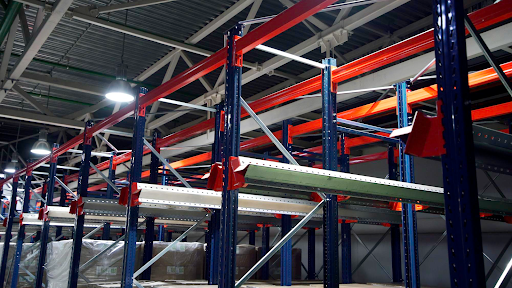
Horizontal beams must securely lock into upright frames using manufacturer-specified connection systems that provide reliable load transfer capabilities. Beam spacing must accommodate the dimensions of stored pallets while maintaining proper load distribution across all connection points.
Load Capacity Considerations
Each beam connection must be capable of handling the specified load ratings without exceeding design limits or creating failure points. Proper beam installation includes verifying that locking mechanisms function correctly and provide secure connections under loaded conditions.
Safety Compliance and Quality Assurance
OSHA Requirement Adherence
Industrial racking installation must comply with OSHA standards that specify minimum aisle widths, load capacities, and structural stability requirements. Proper documentation of installation procedures and load ratings provides legal protection and operational guidance for warehouse personnel.
Final Inspection and Testing Procedures
Installation completion requires a comprehensive inspection of all connections, alignments, and safety features to verify proper system performance. All bolts should be properly tightened and locking mechanisms checked to ensure secure connections throughout the structure.
Common Installation Challenges and Solutions
Floor Irregularity Management
Uneven floors present significant challenges for achieving plumb installation and may require extensive shimming or floor preparation work. Careful measurement and strategic shim placement can compensate for minor irregularities while maintaining structural integrity.
Component Staging and Organization
Efficient component staging reduces installation time and minimises the risk of damage or loss during the construction process. Systematic organisation of parts according to installation sequence helps maintain project momentum and reduces worker confusion.
Post-Installation Maintenance and Monitoring
Regular Inspection Protocols
Ongoing inspection programs help identify wear patterns, damage, and potential failure points before they compromise system safety. Visual inspections should focus on connection integrity, frame alignment, and load distribution patterns throughout the facility.
Load Management Best Practices
Proper load distribution prevents overloading individual components and extends system service life while maintaining safety margins. Training warehouse personnel on load limits and proper loading techniques reduces the risk of equipment damage and safety incidents.
Conclusion
Successful industrial racking system installation requires careful planning, precise execution, and ongoing attention to safety and compliance requirements. The combination of proper site preparation, accurate assembly techniques, and thorough quality assurance creates reliable storage systems that serve warehouses effectively for many years.
Professional installation teams bring the expertise and experience necessary to navigate complex requirements and deliver optimal results. Our team provides comprehensive installation services that prioritise safety, efficiency, and long-term performance for industrial storage applications.