Managing Inventory With Racking Systems: Complete Guide
August 24, 2025Racking System Components And Their Functions
August 25, 2025Multi-Level Racking System Design Considerations Guide
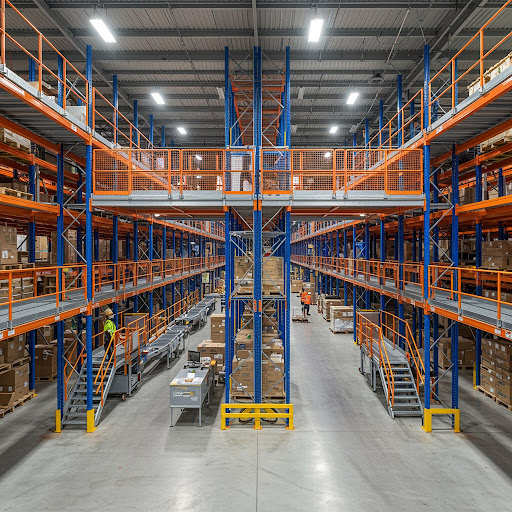
Multi level racking is how Singapore warehouses claim back the storage they cannot get from horizontal expansion. With industrial rents 26.5% above the Q3 2020 trough and prime logistics occupancy approaching 97%, the question for most operators is not whether to go vertical, but how high they can go safely under the design rules that apply.
This guide covers the structural, fire, and operational design layers that decide that answer for a Singapore site.
Quick answer: what governs multi level racking design in Singapore?
Four design layers in sequence. Structural conformance to SS EN 15512 (the Singapore Standard for adjustable pallet racking) governs the steel. SCDF Fire Code 2018 sets sprinkler clearance and 50% perforated decking rules. BC3:2013 covers seismic considerations for tall structures. Operational layout matches velocity bands to height, with fast movers at pick face level and slow movers above. Get the sequence wrong and the cheapest re work is the second cheapest event in the project.
The four design layers
A multi level racking layout in Singapore has to clear four overlapping sets of rules. Each adds constraints that the next one cannot override.
| Layer | Governing reference | What it constrains |
| Structural | SS EN 15512, EN 15620, EN 15635 | Beam capacity, upright frame rating, baseplate loading, bracing geometry, deflection limits |
| Steel materials | BCA BC1:2012 (formerly BC1:2008) | Alternative steel materials to BS 5950, relevant where racking steel is sourced outside European standards |
| Seismic / lateral | BC3:2013 (per SS EN 1998-1) for buildings over 20 m | Notional horizontal loads for shorter buildings, formal seismic actions for tall structures and certain ground types |
| Fire | SCDF Fire Code 2018 | Sprinkler clearance, storage height vs commodity class, perforated decking on upper levels |
The structural layer applies to every rack regardless of height. The fire layer applies the moment storage approaches sprinkler heads. The seismic layer kicks in only on tall buildings and specific ground types, but the bracing principles cascade down to shorter racking installed above 6 m, which still requires bracing calculated against lateral and forklift impact forces.
Load distribution: a worked example
The principle most often misunderstood on multi level layouts is that beam capacity is rated per level, not per pallet. Upright capacity is rated per frame, not per beam.
Consider a 4 level selective rack bay in a Tuas warehouse:
- Pallet weight: 1,200 kg (gross, including product, packaging, pallet base)
- 2 pallets per beam level
- 4 loaded beam levels per bay
- Beam span: 2,700 mm
- Frame height: 6 m
- Frame: standard duty (12,000 kg rated capacity)
Beam level demand:
1,200 kg × 2 pallets = 2,400 kg per beam level
The beam pair must therefore be rated for at least 2,400 kg under uniformly distributed load (UDL). A standard box beam (100 to 125 mm depth, 1.8 to 2.0 mm gauge) at this span typically carries 2,500 to 3,500 kg per pair, so it clears the demand with margin.
Bay total demand:
2,400 kg × 4 levels = 9,600 kg per bay
The upright frame at 12,000 kg rated capacity has approximately 20% headroom. That margin is required by SS EN 15512 to cover dynamic effects (forklift placement, partial overloads, accumulated tolerance). It is not spare capacity for future load increases.
What changes if pallet weight goes up to 1,400 kg:
- New beam level demand: 2,800 kg (still within standard box beam capacity)
- New bay total demand: 11,200 kg (within frame capacity but margin drops to ~7%)
At 1,400 kg pallets the bay is operating within spec but with thinner safety margin. At 1,500 kg the upright frame is effectively at design limit and any operational anomaly (off centre pallet, forklift impact, partial overload on one level) exceeds the design envelope.
This is why pallet weight changes after installation should never be treated casually. The full worked context for these calculations sits in our pallet racking load capacity reference, which lists the load tables we use on tender drawings.
For operations regularly handling pallets above 1,500 kg, heavy duty racking is the correct specification rather than running a standard frame at its limit.
Sprinkler and fire code clearances
SCDF Fire Code 2018 sets two clearances that constrain how high stored goods can sit on a multi level rack:
- Sprinkler heads to top of stored goods. Minimum 500 mm clearance for standard storage classes (commodity class III and below). For higher hazard classes (plastics in cartons, aerosols, certain electronics), the minimum increases to 750 mm or more depending on the sprinkler system design.
- In rack sprinklers. Required where rack height or commodity class exceeds what ceiling level sprinklers can protect. In rack sprinklers sit at intermediate beam levels and impose additional clearance and clearance flueway requirements between back to back rows.
The practical impact on a 6 m clear height building:
- Ceiling sprinklers typically sit ~150 to 300 mm below the slab soffit
- Required 500 mm clearance reduces usable rack reach to approximately 5.2 to 5.4 m
- Decking on upper levels of a multi level installation must be at least 50% perforated (wire mesh or open grid steel) to allow sprinkler penetration to lower levels
Solid timber or solid steel decking on upper levels fails the perforation requirement and is the most common reason multi level layouts get returned at the SCDF approval stage. Wire mesh decks rated 300 to 700 kg/sqm are the default specification for new builds.
Seismic and lateral bracing
Singapore is officially a low seismicity zone, but two factors still drive lateral bracing requirements on multi level racking:
- BC3:2013 (Design Guidebook for Seismic Actions in Singapore to SS EN 1998-1) sets formal seismic action requirements for buildings over 20 m and for ordinary buildings on certain ground types (D and S1). Most single storey warehouses sit below this trigger, but multi storey logistics and ramp up buildings frequently cross it.
- Forklift impact dynamic loads. SS EN 15512 requires racking installed above 6 m to be designed for horizontal forces from forklift entry, braking, and pallet placement impacts. The structural drawings should show diagonal bracing positions and frequency.
Standard configurations:
- X bracing on the back face of each frame, plus horizontal bracing between frames
- D bracing (staggered diagonals) on frames above 6 m where standard X geometry becomes too steep
- K bracing for very narrow aisle and high bay installations where lateral resistance has to come from fewer frames
Bracing is not optional. Removing diagonal struts to widen forklift access is the most common dangerous modification we see in older Singapore warehouses, and EN 15635 inspection classifies missing bracing as a red condition that requires immediate rectification.
Floor flatness and anchoring
Multi level racking transfers cumulative bay loads (9,600 kg in the worked example above; far higher in heavy duty configurations) into the slab through the baseplate footprint. Three slab inputs decide whether a layout is feasible:
| Input | Typical requirement for multi level | What happens if missed |
| Slab thickness | 150 mm minimum, 200 mm for heavy duty and tall installations | Punching shear failure under baseplate, rack settlement |
| Concrete grade | C25/30 minimum | Anchor pullout, baseplate movement under load |
| Floor flatness | DIN 18202 Line 3 (~12 mm deviation over 4 m), tighter for VNA | Rack misalignment, beam to upright connector wear, forklift mast deflection at height |
| Anchor type | M10 or M12 expansion or chemical anchors, 2 to 4 per baseplate | Anchor failure under lateral or uplift loads |
Older flatted factories built in the 1970s and 80s can have slab capacities below these figures. The single most common cause of expensive re work on Singapore multi level projects is committing to a rack height before the existing slab has been verified.
The full design phase verification list sits in our warehouse racking pre installation checklist, which covers 14 inputs used on real projects.
NTL multi level project: 3PL contract logistics, Tuas
The following is an anonymised example from a 2025 NTL Storage installation.
Site: Modern ramp up logistics warehouse in Tuas, 11 m clear height.
Brief: Client needed to triple storage density inside an existing lease without expanding floor footprint. Mixed SKU base for three FMCG brands, ABC velocity profile with ~70% of picks concentrated in 18% of SKUs.
Solution: Three level layout combining configurations.
- Ground level: Very narrow aisle racking for ABC band A fast movers, with guided turret trucks operating in 1.7 m aisles. Reach to 10 m at the pick face.
- Mezzanine level 1 (4 m floor to floor): Selective racking on a rack supported platform, used for band B medium velocity. Wire mesh decking throughout for sprinkler compliance.
- Mezzanine level 2 (3.5 m floor to floor): Longspan shelving on a free standing extension, used for slow moving band C SKUs and seasonal overstock. Hand pick only, no forklift access above ground level.
Structural verification: Designed to SS EN 15512 for the racking, BC3:2013 for seismic actions at 11 m total structure height, BCA QP submission for the rack supported platform, SCDF Fire Code 2018 for sprinklers and 50% perforated decking on both mezzanine levels.
Approvals: 12 weeks across JTC, URA, BCA, and SCDF. Installation: 6 weeks.
Outcome: Pallet positions tripled inside the original lease. The fit out paid back inside 22 months on avoided rental of equivalent space.
A selection of similar completed work sits on our past projects page.
The full cost vs payback analysis for multi level racking versus relocation is covered in our [June 2026 payback analysis. Link pending].
Practical decision sequence
A multi level project that lands on time and on spec follows this order:
- Verify the building. Measure true clear height (floor to lowest fixed obstruction, not slab to slab). Confirm slab thickness, grade, and flatness. Confirm sprinkler position.
- Confirm the SKU profile. Pallet types, dimensions, worst case weights, ABC velocity bands.
- Apply the standards. SS EN 15512 for structural, BC3:2013 for seismic if building exceeds 20 m or sits on relevant ground types, SCDF Fire Code 2018 for clearances and decking.
- Decide the configuration mix. Selective at the pick face, VNA for high density A and B, drive in or double deep for C band, mezzanine or rack supported platform for hand pick zones above forklift reach.
- Run the load calculations. Beam level demand × levels = bay demand. Compare against frame rating with at least 15% headroom.
- Specify accessories and inspection cadence. Wire mesh decks, column protectors, end of aisle guards, EN 15635 inspection schedule.
For the broader configuration mix question (which subcategory suits which zone), our pallet racking systems range page covers selective, double deep, drive in, VNA, and heavy duty with use case fit.
Inspection and ongoing safety
Multi level racking concentrates risk because damage to any one component on a lower level cascades through the bay above. EN 15635 recommends daily visual checks by warehouse staff, weekly walk arounds by a trained supervisor, and an annual inspection by a competent person.
Common failure points specific to multi level installations:
- Forklift impact damage to ground level uprights, which compromises the cumulative bay load path
- Missing or removed bracing on lower frames (most common red condition we see)
- Sprinkler clearance violations from over stacked pallets on upper levels
- Wire mesh deck damage on mezzanine and rack supported platform levels
Rack inspection in Singapore outlines the EN 15635 traffic light classification (green, amber, red) and what each level means for continued operation.
Conclusion
Multi-level racking system design considerations encompass a complex interplay of structural engineering, operational requirements, safety regulations, and business objectives that require expert analysis and planning. Successful implementations demand careful attention to dimensional accuracy, load calculations, safety compliance, and operational workflow optimisation to achieve maximum return on investment.
The complexity of these systems and their critical impact on warehouse operations make professional guidance essential for optimal results. Our team provides comprehensive design services and expert consultation to ensure your multi-level racking system delivers maximum efficiency, safety, and long-term value for your storage operations.