Warehouse Racking Installation Timeline in Singapore
March 3, 2026
Pallet Racking Load Capacity Singapore Guide
March 3, 2026
Warehouse operators comparing selective vs drive in racking Singapore are usually solving one problem: how to store more pallets without paying for a larger unit. The wrong configuration locks you into wasted cubic space or operational bottlenecks. This blog will walk you through how each system performs in storage density, pallet accessibility, and long-term rental efficiency.
What Selective Racking Is
Selective racking is a pallet storage system built with upright frames and horizontal beams arranged in parallel aisles. Each pallet position is directly accessible, which makes it suitable for warehouses that need faster retrieval, more flexible picking, and easier SKU-level access.
In most operations, selective racking gives stronger accessibility but lower storage density than drive-in systems. It is commonly used when direct pallet access matters more than fitting the highest possible number of pallets into the same footprint.
For system design and specifications, see the selective racking system page.
Key characteristics of selective racking
- direct access to every pallet
- easier retrieval and replenishment
- wider aisle requirement
- stronger fit for FIFO operations
- better flexibility for mixed inventory
What Drive-In Racking Is
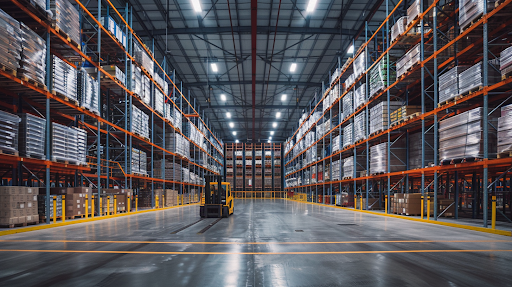
Drive-in racking is a high-density pallet storage system where forklifts enter storage lanes and place pallets on side rails. Because fewer aisles are needed, the system can increase pallet positions within the same floor area.
It is usually more suitable for bulk storage with lower SKU variety, where density matters more than direct access. In most warehouses, drive-in improves space utilisation but reduces immediate pallet accessibility compared with selective racking.
For system design and layout details, see the drive-in and drive-through racking system page.
Key characteristics of drive-in racking
- higher storage density
- reduced aisle count
- lower pallet accessibility
- usually aligned with LIFO flow
- better suited to repeated bulk pallet storage
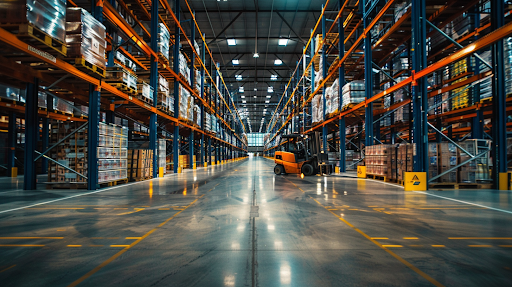
Selective vs Drive-In Racking: Comparison Table
| Comparison factor | Selective racking | Drive-in racking |
| Pallet accessibility | Direct access to every pallet | Limited direct access within lane |
| Storage density | Moderate | High |
| Forklift requirement | Standard aisle access forklift operation | Forklift enters lane and needs tighter handling control |
| Ideal SKU count | Higher SKU variety | Lower SKU variety |
| Replenishment speed | Faster retrieval and replenishment | Slower retrieval when lane depth increases |
| Inventory flow | FIFO-friendly | Usually LIFO unless drive-through layout is used |
| Best warehouse use case | Mixed inventory, frequent picking, fast-moving stock | Bulk storage, repeated SKU blocks, denser pallet storage |
Accessibility Comparison
Selective racking gives direct access to every pallet position, which is why it is usually preferred for operations with more SKU variety or faster stock movement. Forklift drivers can approach individual pallet positions directly without entering storage lanes.
Drive-in racking improves density by reducing aisle count, but that also reduces direct pallet accessibility because pallets are stored in lanes. Forklifts must enter the rack structure to place and retrieve pallets.
For warehouses where retrieval speed and flexible access matter, selective racking is usually the stronger option. For warehouses where bulk storage matters more than retrieval flexibility, drive-in can be more space-efficient.
Storage Density Comparison
Drive-in racking usually achieves higher storage density than selective racking because it removes more aisle space and increases storage depth per lane. In a warehouse with the same floor area and ceiling height, drive-in can support significantly more pallet positions than a selective layout.
Selective racking uses more aisle space, so total pallet count is usually lower. However, higher density alone does not decide suitability. The better question is whether higher density improves total warehouse efficiency after access speed, labour, and replenishment logic are considered.
In practical terms:
- choose density first only when bulk storage is the operating priority
- choose access first when pallet retrieval speed matters daily
- compare cost per pallet position together with handling efficiency, not separately
FIFO vs LIFO: Which Inventory Flow Fits Each System
Selective racking is generally more compatible with FIFO inventory flow because each pallet can be accessed directly. This makes it easier to manage stock rotation in warehouses where expiry sensitivity, picking speed, or sequencing matters.
Drive-in racking is usually associated with LIFO flow because the last pallet placed into the lane is often the first one retrieved. Mecalux’s 2024 explanation of LIFO uses and examples specifically identifies drive-in racking as a high-density system suited to LIFO handling, especially where businesses store a small variety of SKUs with many pallets per SKU.
FIFO usually requires drive-through configuration with separate loading and unloading sides, which changes layout requirements and operating flow.
In practical terms:
- choose selective racking when FIFO handling matters
- choose drive-in when LIFO is operationally acceptable
- consider drive-through only when the warehouse layout can support separate flow sides
Best for High-SKU vs Bulk-Storage Operations
Selective racking is generally better for high-SKU operations because each pallet is easier to access without moving surrounding stock. It works well for mixed inventory, frequent picking, and faster turnover.
Drive-in racking is usually better for bulk-storage operations where fewer SKUs occupy more pallet positions. If one SKU occupies a large number of pallets, drive-in often improves density more effectively than selective racking.
A simple way to decide:
- many SKUs with smaller pallet counts usually favour selective
- fewer SKUs with larger pallet blocks usually favour drive-in
- high movement frequency usually favours selective
- deeper reserve storage usually favours drive-in
Cost and Forklift Implications
Drive-in racking can reduce rental cost per pallet position because it increases storage density within the same footprint. However, that does not automatically mean lower total operating cost.
Because forklifts must enter rack lanes, retrieval can be slower and impact risk can be higher if the system is not designed and operated properly. Selective racking usually uses more floor area per pallet, but it can improve picking speed, reduce reshuffling, and simplify forklift movement. This is also why warehouse safety guidance from OSHA on warehousing hazards and solutions recommends protecting rack uprights from forklift contact and isolating damaged racking immediately, since impact damage can affect both safety and ongoing operating cost.
Cost should therefore be evaluated through both:
- space efficiency
- operational efficiency
- forklift movement pattern
- impact protection requirement
- labour time per pallet movement
Decision Matrix: Which Racking System Should You Choose
Choose selective racking when:
- you need direct access to every pallet
- SKU variety is high
- FIFO handling matters
- picking speed matters
- future reconfiguration is likely
- retrieval efficiency is more important than maximum density
Choose drive-in racking when:
- storage density is the main priority
- SKU count is lower
- pallets are stored in repeated bulk quantities
- LIFO flow is acceptable
- rental pressure is high
- lane-based storage works operationally
If the warehouse depends on quick access, selective is usually the safer decision. If the warehouse depends on fitting more pallets into the same footprint and the inventory profile is suitable, drive-in is usually the stronger density solution.
Conclusion
Selective and drive-in systems solve different storage problems. One prioritises accessibility. The other prioritises density. The right choice reduces effective rental cost per pallet position without compromising workflow.
If you are planning warehouse optimisation, consult NTL Storage for a layout assessment that evaluates pallet count, turnover rate, and future growth before recommending a system. A structured design decision prevents costly restructuring later.
FAQs About Selective vs Drive-In Racking in Singapore
What is the difference between selective and drive-in racking?
Selective racking gives direct access to every pallet, while drive-in racking increases storage density by storing pallets in deeper lanes with fewer aisles.
Which racking system suits bulk storage better?
Drive-in racking usually suits bulk storage better because it increases pallet density and works well when fewer SKUs are stored in larger quantities.
Which system is better for high-SKU operations?
Selective racking is usually better for high-SKU operations because it allows direct access to each pallet and supports faster picking.
Does drive-in racking always reduce rental cost?
Not always. It can reduce rental cost per pallet position, but slower retrieval, higher impact risk, and operational inefficiencies can reduce the total savings.
Can drive-in racking support FIFO?
Standard drive-in racking is usually LIFO. FIFO generally requires drive-through configuration and suitable loading and unloading access.
Which system is easier to reconfigure later?
Selective racking is usually easier to reconfigure because beam levels and bay layouts can be adjusted more flexibly than drive-in lane structures.
Which system is better for faster replenishment?
Selective racking is usually better for faster replenishment because each pallet position is easier to reach directly.