Cantilever Racking for Long Loads: Pipes, Lumber & Steel
April 24, 2026
Boltless Shelving for Small Warehouses: When It Beats Racks
April 24, 2026
Heavy duty pallet racking applications go well beyond routine warehouse storage. Engines, metal coils, machine parts, and moulds all sit outside what standard pallet racks were built for. This blog will walk you through the four load profiles that demand a heavy duty racking system, how to size beams and uprights correctly, and where the common sizing mistakes sit.
What “heavy duty” actually means in pallet racking
Selective racking in most Singapore warehouses carries 1,000 to 1,500 kg per pallet position, with beam UDL (uniformly distributed load) in the 2,000 to 3,000 kg range depending on beam length. Standard pallet racking systems hit a ceiling there. Heavy duty pallet racking starts where that ceiling ends.
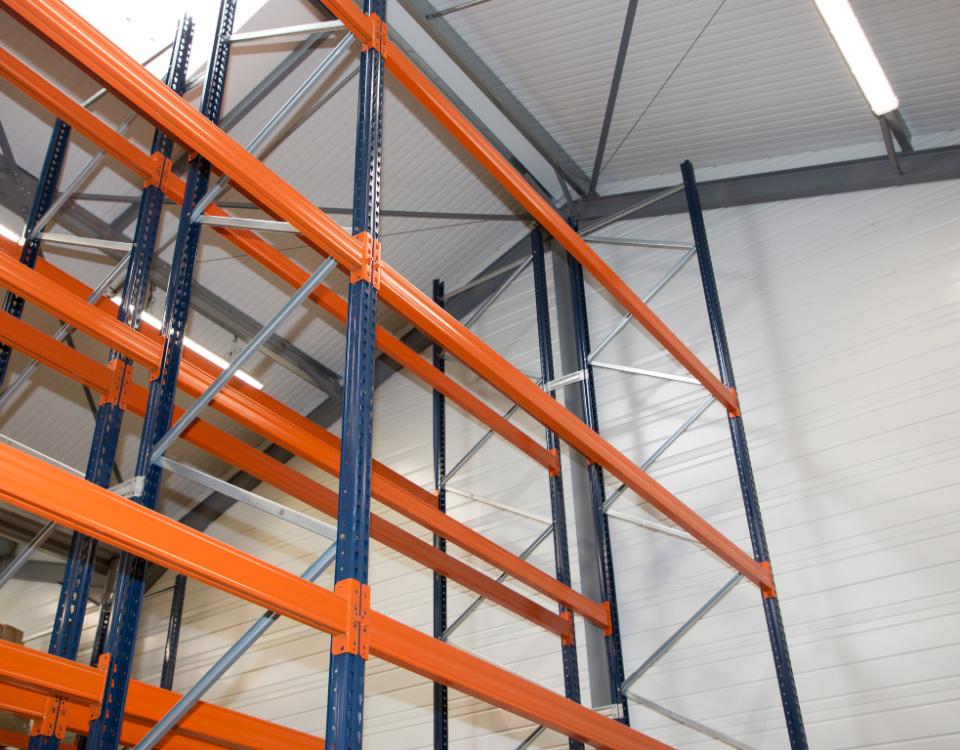
A true heavy duty rack uses a reinforced upright frame in heavier gauge steel, usually 2.5 mm to 3.0 mm column profile instead of the 1.8 mm to 2.0 mm used for standard selective systems. Beams are thicker at the top and bottom flanges, often step-beam or box-beam profiles, and carry UDL ratings from 3,000 kg upward. Industrial installations storing engine blocks, coil stock, or heavy tooling can run 4,000 kg to 5,000 kg UDL per level.
The jump is not only about thicker steel. Heavy duty frames use larger base plates, more anchor bolts per column, and stiffer horizontal and diagonal bracing. Seismic brackets and safety pins become standard rather than optional. Beam connectors are engineered for impact and fatigue, because a forklift strike on a 3,000 kg loaded beam is more destructive than a strike on a 1,000 kg beam.
Heavy duty is a structural upgrade, not a sticker upgrade. It changes material gauge, connection method, anchoring, and the forklift class allowed in the aisle.

The four load profiles that drive heavy duty sizing
Each application stresses the rack differently, and each has a different failure mode.
Engine blocks and powertrain assemblies
An engine block sits on a pallet or skid but concentrates most of its mass in a small footprint. A 400 kg V8 block on a 1200 by 1000 mm pallet pushes point loads into the beam that a uniform pallet load of the same weight does not. That concentrated loading is the reason engine block storage racks usually specify reinforced beam profiles, steel decking panels instead of wire mesh, and shorter beam spans to reduce mid-span deflection.
Automotive remanufacturing warehouses and engine rebuild shops in Tuas and Jurong industrial areas frequently run 2 tonne pallet racking (2,000 kg per pallet position) with step-beam profiles. Stock rotation matters here. Engine cores move in and out with forklift handling that is often rougher than FMCG handling, so rack damage tolerance matters more than storage density.
Metal coils and coil stock
Coil storage breaks untrained rack designers. A 1 tonne steel coil is not a static load. It wants to roll. Stored flat on a pallet, the coil creates lateral force the pallet racking was never engineered to handle.
The correct specification is a cradle beam or saddle beam that locks the coil in a V-shape or arc profile. The rack still looks like pallet racking from the aisle, but the beams are shaped to hold the coil. UDL ratings for coil storage usually start at 3,000 kg per level for small coils and climb to 5,000 kg or more per level for larger diameters. Coil stock for slitting operations, stamping lines, and sheet metal fabricators needs this configuration, not a standard flat beam.
Machine parts, dies, and tooling
Machine parts and dies vary widely in weight and footprint. A small die for a metal stamping press can weigh 150 kg. A large progressive die or press tool can weigh 2,000 kg or more. The pallet footprint is small but the weight is concentrated, which means the rack sees high point loads near the centre of the beam span.
Die storage racks usually specify heavy gauge upright frames for concentrated beam loads, shorter beam spans around 1.8 m or 2.1 m, steel deck panels rated for point load, and forklift-compatible access with anti-slide features. The shorter span is the key decision. A 2.7 m beam rated for 2,500 kg UDL is not rated for a 2,500 kg point load at mid-span. Die storage should be sized for worst-case placement, not best-case distribution.
Moulds and injection moulding tools
Mould tool storage sits at the heavy end of this list. An injection mould for a medium consumer-plastic part routinely weighs 1,000 kg to 2,500 kg. Tooling for large automotive interior moulds can hit 5,000 kg per tool. Mould tool racks typically use pull-out mould drawers or reinforced flat deck beams with anti-roll features, because moulds cannot be handled like standard pallets.
Plastic injection moulding shops in Singapore’s manufacturing cluster tend to run a mix: floor storage for active moulds, racking for reserve tooling, and occasionally mould pull-out trays for high-value tools. Rack specification changes based on tool access frequency and the lifting equipment available.

Beyond load rating: what actually drives the spec
Heavy duty rack sizing is not a single number. It is a stack of decisions that compound.
Reinforced upright frame and column gauge
The upright column is the structural backbone. Standard selective racking uses column profiles around 90 x 60 mm in 1.8 to 2.0 mm gauge steel. A reinforced upright frame for heavy duty use steps up to 100 x 80 mm or 120 x 90 mm profiles in 2.5 to 3.0 mm gauge. The upright does not only carry the vertical load. It resists forklift impact, eccentric loading when beams are loaded unevenly, and lateral force from seismic or traffic vibration.
Beam profile and UDL
Beam UDL is the value you see quoted, but how the beam fails matters more. A step beam rated at 3,000 kg UDL may deflect within allowable limits under even loading and still bend permanently after one 2,500 kg point load at mid-span. For heavy duty applications, beam thickness at the top and bottom flanges matters more than the nominal UDL. Box-beam profiles and thicker step-beams are standard on rated heavy duty systems. The RMI guidance on load capacity calculations under ANSI MH16.1-2021 now requires nine specific site-based design factors, not simple frame tables, which is the right direction for heavy duty stock where point loads vary.
Safety pin, beam clip, and seismic bracket
A safety pin locks the beam to the upright so the beam cannot lift out under upward forklift impact. On standard racking, pins are often treated as a tick-box. On heavy duty racking, they are structural. Seismic brackets strengthen the column-to-baseplate connection against lateral movement, which matters for any warehouse with heavy forklift traffic at rack ends. Seismic considerations for racking design still apply for heavy industrial stock in Singapore because local soil profile and building response can amplify lateral forces at rack height.
Base plate, anchoring, and slab capacity
Every kilogram on the rack transfers to the warehouse floor through the base plate. A heavy duty bay at 6,000 kg (three levels of 2,000 kg each) pushes 6,000 kg plus rack self-weight into two base plates. Slab capacity matters. A 150 mm reinforced slab rated for 10 kN per square metre is adequate for most standard racking. Heavy duty installations may require 15 kN per square metre, or localised slab reinforcement under column lines.
The slab check belongs in the site visit, before quotation, not after fabrication. Our guide on pallet racking load capacity in Singapore explains how rated load, actual load, and slab capacity interact on real warehouse projects.
Installation, inspection, and forklift safety
Heavy duty racking fails differently from standard racking. Standard rack failures are usually incremental: a bent beam, a dented upright, gradual deflection. Heavy duty failures can be sudden because the stored loads are large and consequences are serious.
Column protectors at aisle corners are not optional on heavy duty systems. A 3 tonne engine block on a damaged upright is a very different conversation from a 500 kg pallet on a damaged upright. The upright specification must be validated against realistic forklift impact, and the layout should include guard rails, end-of-aisle protection, and clearly marked forklift zones.
Scheduled inspection is where most warehouses fall short. The SEMA guide to pallet racking inspections sets the industry benchmark for inspection frequency, damage classification (green, amber, red), and repair triage. For heavy duty installations, inspection should happen monthly by a trained staff member and annually by a competent rack inspector. Singapore warehouses typically implement structured rack inspection procedures aligned with SEMA methodology.
Fire safety compliance also applies. The SCDF Fire Code 2023, Clause 9.8 sets requirements for storage height, sprinkler clearance, and aisle access in warehouse occupancies. Heavy duty racks loaded with oil-contaminated engine parts or combustible mould wax may trigger additional fire protection requirements beyond standard warehouse storage.
When heavy duty pallet racking is the wrong pick
Heavy duty racking is more expensive per bay than standard selective racking. Over-specifying adds capex without operational benefit.
For long loads like steel pipe, timber, or extruded profiles, a cantilever racking system is the correct pick, not heavy duty pallet racking. Open-front arm geometry handles length in a way pallet racks cannot, regardless of how heavy the beams are.
For mixed inventory where only 20% of stock is heavy industrial, running heavy duty bays across the whole warehouse wastes capex. Hybrid layouts with standard selective racking for lighter pallets and heavy duty bays for the concentrated heavy items usually deliver better total value.
The question during design is practical: what is the heaviest unit load per pallet position, and how often does that load appear? If the answer is “occasionally 2 tonnes but mostly 800 kg,” your design point is 2 tonnes in a defined zone, not everywhere.
Conclusion
Heavy duty pallet racking earns its cost when stored loads push past standard beam UDL, concentrate weight in small footprints, or carry real consequences if a beam bends under impact. Engines, coils, dies, and moulds each stress the rack in a different way. Size the reinforced upright frame, beam profile, anchoring, and slab capacity to the specific application, not to a generic spec sheet.
If you are planning storage for heavy industrial stock or reviewing an existing heavy duty rack configuration, speak with NTL Storage for a site assessment covering load profile, beam and upright selection, slab capacity, and forklift access before fabrication starts.
FAQs About Heavy Duty Pallet Racking Applications
What is heavy duty pallet racking used for?
Heavy duty pallet racking is used to store concentrated or oversized loads that exceed standard rack ratings. Common applications include engine block storage, metal coil stock on cradle beams, die and tooling storage, and mould tool racks for injection moulding shops. It uses reinforced upright frames, heavier beam profiles, and UDL ratings from 3,000 kg upward per level.
What is the load rating for heavy duty pallet racking?
Heavy duty pallet racking UDL usually starts at 3,000 kg per level and can exceed 5,000 kg for specific industrial configurations. Standard selective racking tops out around 2,000 to 3,000 kg UDL. Rated capacity depends on beam length, profile, upright gauge, bracing, and anchoring. Always verify capacity per specific beam length, not the headline number.
Is 2 tonne pallet racking the same as heavy duty?
2 tonne pallet racking (2,000 kg per pallet position) sits at the top of standard selective racking and the entry point of heavy duty. True heavy duty installations often run 2,500 kg to 3,000 kg per pallet position with reinforced upright frames, seismic brackets, and larger base plates. The label “2 tonne” alone does not confirm the structural grade.
Can heavy duty pallet racking store mould tools and dies?
Yes. Heavy duty pallet racking is commonly used for mould and die storage. Design considerations include reinforced beam profiles for concentrated point loads, steel deck panels rated for small-footprint loads, shorter beam spans around 1.8 m to 2.1 m, and forklift-compatible access. Very heavy moulds often need specialised pull-out mould racks instead of beam-based racking.
What safety features are standard on heavy duty racking?
Standard heavy duty safety features include safety pins locking beams to uprights, column protectors at aisle corners, end-of-aisle guard rails, seismic brackets at base plates, steel deck panels for point loads, and clearly posted load rating signs. Scheduled rack inspection aligned with SEMA guidance catches damage before structural failure.