Warehouse Racking Pre-Installation Checklist: 14 Items
April 25, 2026
Industrial racking in Singapore rarely fits one system. Factories storing engine blocks need different steel than warehouses moving pallets, and neither suits a yard stacking 6-metre bars. This blog will walk you through how pallet, heavy duty, and cantilever systems fit Singapore industrial operations, with the load specs and standards behind every warehouse racking systems decision.
What “industrial racking” actually means for Singapore factories and yards
Industrial racking covers any steel storage structure rated for forklift-loaded or heavy hand-loaded operations. The defining specs are beam load (kg UDL per beam pair), upright capacity (total kg per upright frame), and compliance with a recognised design code. Light-duty consumer shelving sits outside the category.
Most Singapore industrial sites operate out of JTC industrial estates in Tuas, Jurong, Woodlands, Yishun, Senoko, or Loyang. Ground-floor slabs in those buildings are typically rated for 15 to 30 kN per square metre, which gives racking designers room to work with anchored baseplates and full pallet loads. Mezzanine floors are tighter at 5 to 7.5 kN per square metre and need separate load calculations before any rack goes in.
The three systems covered below handle the bulk of factory and warehouse storage needs in Singapore. Each one earns its place against a specific load profile, and using the wrong system pushes cost up either during install or in operating waste over time.
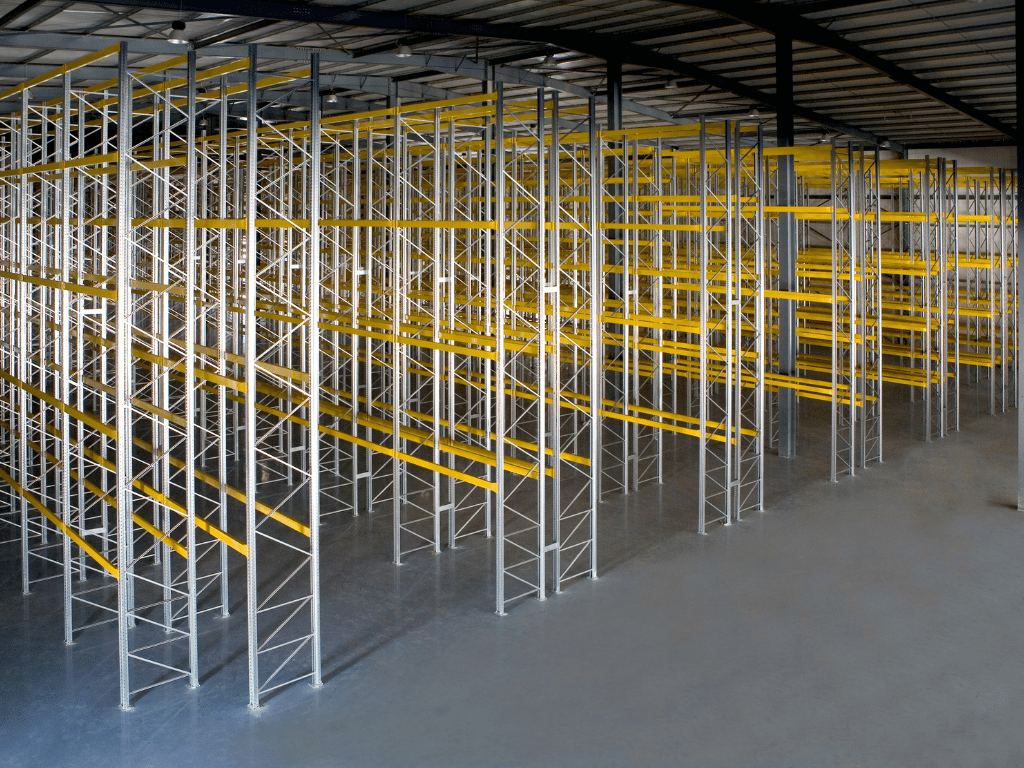
Pallet racking for warehouse and factory bulk storage
Pallet racking is the default system for any operation handling stock on standard pallets. The most common pallet sizes in Singapore are 1,000 x 1,200 mm and 1,100 x 1,100 mm. Beam loads typically range from 1,500 to 3,000 kg per pair, sized to hold two or three pallets per beam level.
Selective pallet racking
Selective is the most common variant. Every pallet is directly accessible from the aisle, which suits operations with many SKUs and frequent stock rotation. Aisle widths run 2.6 m to 2.9 m for reach trucks, or 3.2 m to 3.5 m for counterbalance forklifts. The pallet racking systems catalogue covers selective, double-deep, drive-in, drive-through, and very narrow aisle variants under one product family.
Density variants for high-volume bulk pallet flow
Drive-in and double-deep racking trade access for density. Drive-in holds 8 to 12 pallets deep per lane and works well for single-SKU bulk storage, including cold storage operations. Double-deep holds two pallets back-to-back per face, recovering roughly 30 percent more density than selective. Very narrow aisle (VNA) keeps full selectivity at 1.5 m to 1.8 m aisles using turret trucks, which suits high-SKU operations chasing density without losing direct pallet access.
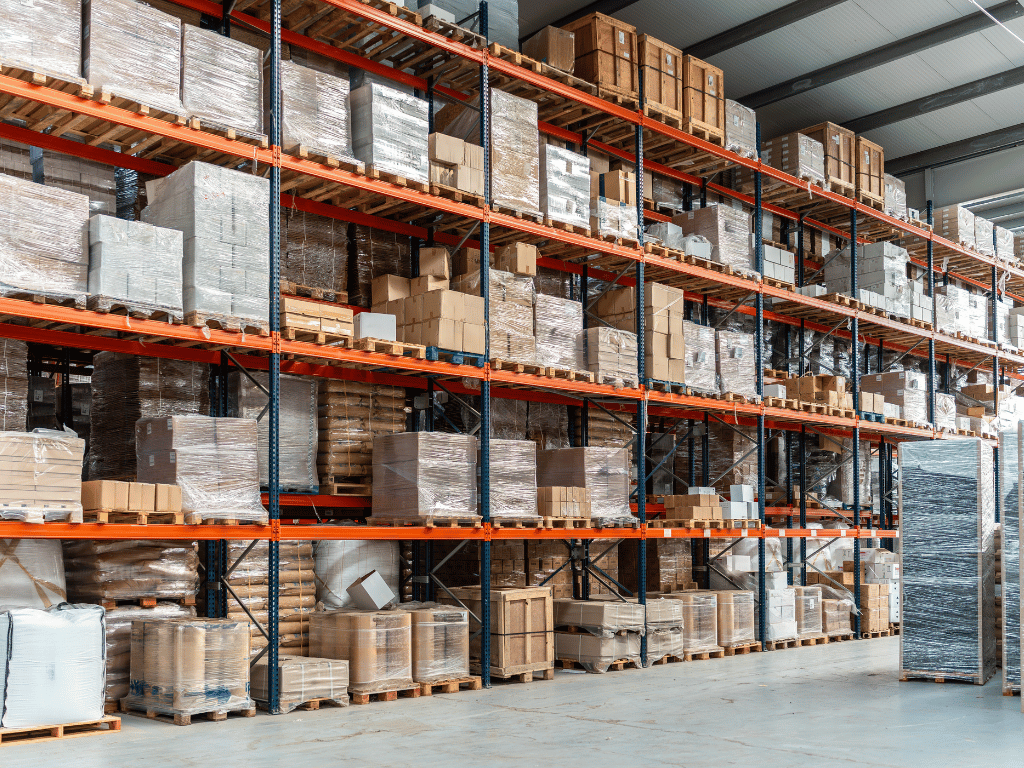
Heavy duty racking for engines, moulds, and machined parts
Heavy duty racking handles loads that pallet racking cannot. The structure uses thicker upright profiles (100 mm to 120 mm typically), stronger beam connectors, and higher gauge steel. Upright capacities run 5 to 15 tonnes per frame pair, with beam loads of 2,500 kg to 5,000 kg per pair.
The applications cluster in specific sectors. Automotive workshops and engine remanufacturers store engine blocks, gearboxes, and crank assemblies at 200 kg to 800 kg per item. Tooling and injection moulding facilities hold metal dies and moulds at 800 kg to 2,000 kg per unit. Heavy machinery distributors carry metal coils, machined parts, and finished assemblies that exceed standard pallet racking limits.
A typical heavy duty racking system installation in a Singapore tooling factory might run 7 tonnes per upright pair with 3,000 kg beam loads, configured for forklift access at 2.9 m aisles. For specific load profiles by application, the heavy duty racking applications guide walks through real cases from engine storage to mould racks.
Loading method matters as much as load weight. Engines and moulds are usually loaded by forklift from the open face. That requires beam levels sized to fit the load plus 100 mm vertical clearance, and floor anchoring rated for the higher point loads transferred through the baseplates.
Cantilever racking for long, oversized, and irregular loads
Cantilever racking holds stock where length exceeds pallet footprint. Pipes, lumber, steel bars, extruded aluminium, plywood, and PVC sheets all belong here. Pallet racking with beams shorter than the load cannot hold these items safely.
The structure uses vertical columns with horizontal arms cantilevered off one or both faces. Arm capacities typically range 250 kg to 1,500 kg per arm. Total column capacity runs 3 to 10 tonnes depending on arm count and column height.
A standard cantilever racking system for a Singapore steel stockist might use 4 m tall single-sided columns with five arm levels at 750 kg per arm, suitable for 6 m steel bars. For lumber and timber yards, double-sided cantilever doubles capacity per linear metre of column footprint. The cantilever racking for long loads guide covers arm sizing, base anchoring, and yard versus indoor installations.
Cantilever installations need the same anchoring discipline as pallet racking. Baseplates anchor to the slab using expansion or chemical anchors rated for design uplift. Arm pitch (vertical spacing between arms) is set by the worst-case load length and weight, and the column footprint depth has to accommodate the heaviest forward moment from a fully loaded arm.
Standards and compliance for industrial racking in Singapore
Industrial racking installed in Singapore is engineered to one of two primary structural codes.
SS EN 15512 is the European standard for adjustable pallet racking, covering structural design, manufacturing tolerances, and component testing. Most racking supplied across Singapore references this code in the structural calculations.
BC1:2008 is the Singapore design code for the structural use of steel buildings, published by the Building and Construction Authority. It covers load combinations, material specifications, and the seismic provisions that apply even in a low-seismic-risk zone. Tall installations and mezzanine-integrated racks typically need design checks against BC1:2008 in addition to SS EN 15512.
For projects above certain thresholds, Professional Engineer (PE) endorsement is required on the structural drawings. The exact threshold depends on rack height, whether the rack is rack-supported (carrying a mezzanine floor) or free-standing, and the building authority’s classification of the structure.
Operator-side compliance sits under the Workplace Safety and Health Act. The WSH Council BizSAFE framework sets the requirements for training, risk assessment, and annual rack inspection. Operating without documented inspection puts the warehouse occupier in breach of statutory duty, regardless of how well the racking was originally installed.
A credible industrial rack supplier issues stamped design drawings referencing the applicable codes, supplies steel test certificates, and provides PE endorsement where required.
Matching the system to your factory or warehouse
Three operating inputs decide the system mix.
Load weight per unit
Under 1,500 kg per pallet equivalent points to standard pallet racking. Between 1,500 kg and 5,000 kg points to heavy duty. Long or irregular loads point to cantilever, regardless of unit weight.
Load shape and length
Stock that fits a 1,200 mm pallet belongs on pallet or heavy duty racking. Stock longer than 2 m or with no pallet base belongs on cantilever. Mixed inventory often needs two systems in adjacent zones.
Access method
Forklift loading drives aisle widths of 2.6 m or wider. Sideloader access to cantilever yards needs 3.5 m to 4.5 m of aisle. Hand loading is rare in industrial applications, but appears in tooling stores where unit weight allows.
Singapore factories often run a hybrid. Pallet racking holds finished goods. Heavy duty holds tooling, moulds, and heavy components. Cantilever takes the raw materials. The mix is normal, and the layout should be drawn around all three systems together, not bolted on one zone at a time after move-in.
Picking the right system for your facility
The right industrial racking is the one that matches the actual load profile, access method, and floor capacity of the facility, not the cheapest quote per bay. Pallet racking handles bulk pallet flow. Heavy duty holds the engines, moulds, and heavy components that pallet racks cannot. Cantilever takes the long and irregular stock that pallets do not fit.
If you are scoping a fit-out for a new JTC unit, a factory expansion, or a yard installation in Singapore, NTL Storage can survey the site, model the load profile against the right system mix, and supply the steel and installation under one contract.
Talk to NTL Storage about an industrial racking site survey.
Frequently Asked Questions
What is industrial racking?
Industrial racking covers any steel storage structure built for factory or warehouse use, rated for forklift-loaded or heavy hand-loaded operations. The defining specs are beam load (kg UDL per beam pair), upright capacity (kg per frame), and compliance with codes like SS EN 15512 or BC1:2008. Light-duty consumer shelving is not classified as industrial racking.
What’s the difference between heavy duty racking and pallet racking?
Pallet racking is sized for standard pallets at 1,500 to 3,000 kg per beam pair. Heavy duty racking uses thicker uprights of 100 to 120 mm and stronger beams to handle 2,500 to 5,000 kg per beam pair, with upright capacities up to 15 tonnes per frame. It is built for engines, moulds, metal coils, and machined parts that exceed pallet racking limits.
When should I use cantilever racking instead of pallet racking?
Use cantilever racking when stock is longer than 2 m, irregular in shape, or has no pallet base. Pipes, steel bars, lumber, plywood, extruded aluminium, and PVC sheets all belong on cantilever. Pallet racking cannot safely hold loads that overhang beam ends, which is why steel stockists and timber yards default to cantilever systems.
What standards apply to industrial racking in Singapore?
SS EN 15512 covers structural design for adjustable pallet racking. BC1:2008 from BCA covers structural use of steel in buildings, including load combinations and seismic provisions. Operating compliance falls under the Workplace Safety and Health Act and the WSH Council BizSAFE framework, which requires annual rack inspection and documented risk assessment for warehouse occupiers.
Does a racking project in Singapore need PE endorsement?
Professional Engineer endorsement is required on structural drawings for racking above certain height thresholds, for rack-supported mezzanines, and for racking integrated into building structures. Free-standing pallet racking at standard heights usually does not require PE sign-off, but the contractor should still supply stamped design drawings referencing SS EN 15512 or BC1:2008 calculations.