
Drive-In Racking Pallet Capacity: How to Calculate It
May 31, 2026
A pallet racking upright frame is the structural backbone that carries every kilogram in the warehouse. Its dimensions, load rating, and condition decide whether the rack stays safe under load. This blog will walk you through how upright frames are sized, what their capacity actually depends on, and the damage thresholds that flag an upright for replacement across pallet racking systems installations.
What an upright frame actually is
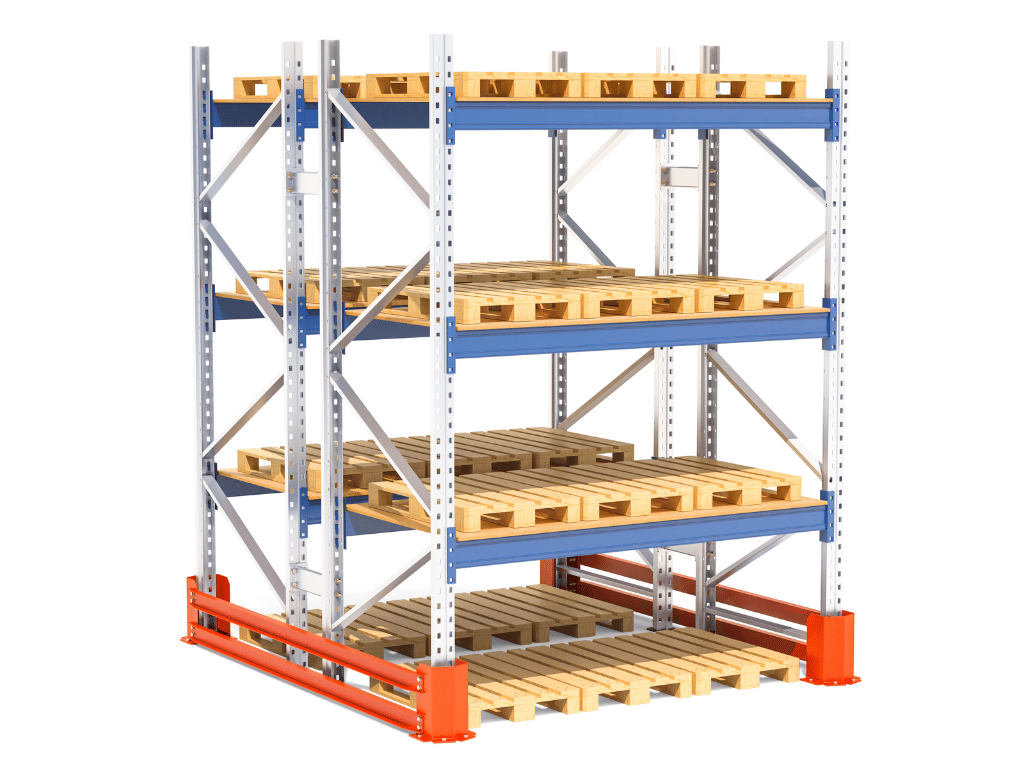
An upright frame is the vertical assembly that beams hang off. Each frame consists of two upright posts (the columns), horizontal braces, diagonal lacing braces, two base plates, and the anchor bolts holding it to the floor.
The posts carry vertical load down to the slab. The horizontal and diagonal braces form a stiffened lattice that resists sway, twisting, and buckling under load. The base plate distributes the vertical and uplift forces into the slab through the anchor bolts.
Frame components work as a system. Replacing only a damaged post without checking braces and base plate is a partial repair, because the same forklift impact that bent the post often deformed nearby connections that are not visible at first glance. Frame integrity is graded against the whole assembly, not the individual parts.
Standard upright frame dimensions
Frame depth
Frame depth is the distance between the front and rear post, measured perpendicular to the aisle. Singapore selective pallet racking installations run two standard depths.
900 mm depth holds 1,000 mm deep pallets stored stringer-in (with the 1,000 mm edge facing the aisle). The pallet overhangs the front and back posts by roughly 50 mm each, which is the industry standard clearance.
1,100 mm depth is the Singapore default for 1,000 x 1,200 mm pallets stored stringer-out (with the 1,200 mm edge facing the aisle). Most NTL Storage selective pallet racking installations run this depth because it matches the dominant pallet used in Singapore industrial supply chains.
A few less common depths exist. 600 mm and 800 mm depths appear in light pallet and longspan crossover installations. 1,200 mm depth appears in heavy duty applications where the pallet sits flush with the upright. The right depth follows the pallet, not the catalogue default.
Frame height
Singapore frame heights typically run 2,400 mm to 12,000 mm depending on building ceiling and forklift fleet. Common SME heights are 4 m, 5 m, 6 m, and 8 m. The 6 m frame is the default for reach truck operations in JTC industrial estates, supporting five to six pallet levels.
Frames above 8 m typically use a splice connection, where two shorter frames are joined vertically with a fish-plate splice. The splice has to develop full upright capacity at the connection, which means it cannot sit at the same level as the pallet load. Specifying splice position correctly is part of the upright design, not an afterthought.
Post profile and steel gauge
Standard pallet rack post profiles run 70 mm to 90 mm in cross-section depth, fabricated from 1.8 mm to 2.0 mm steel gauge in a rolled C-section or step profile. Heavy duty posts step up to 100 mm to 120 mm with 2.0 mm to 2.5 mm gauge.
The deeper the profile, the higher the buckling resistance under axial load. The thicker the gauge, the higher the section modulus carrying beam load down to the slab. A 90 mm post rated 8 tonnes per frame and a 100 mm post rated 12 tonnes are not interchangeable, even though they look similar at a glance. The heavy duty racking system catalogue covers the spec differences across applications.
Load capacity and what affects it
Upright frame load capacity is the maximum total weight the frame can carry across all beam levels combined, expressed in tonnes per frame. Standard pallet racking frames in Singapore typically run 6 to 12 tonnes per frame. Heavy duty frames run 12 to 20 tonnes or higher.
The published frame capacity assumes specific conditions. Change any one of them and the real capacity changes too.
What reduces frame capacity in practice
Beam level spacing
Frames with widely spaced beam levels carry less load than frames with closely spaced beams. The unsupported length of the post between beams determines buckling resistance. A 6 m frame with two beam levels at 2 m spacing has lower capacity than the same frame with four beam levels at 1.2 m spacing.
Anchor condition
Anchor bolts that have loosened, corroded, or pulled out of the slab partially reduce frame capacity sharply. A frame designed for 10 tonnes assumes intact M12 anchors at full embedment. Loose or missing anchors cut effective capacity by 30 to 50 percent.
Floor flatness
Frames installed on out-of-tolerance slabs experience uneven baseplate loading. One baseplate carries more than its share, which reduces total frame capacity and raises the risk of localised yielding at the overloaded base.
Damage to posts or braces
Even small dents or bends in posts can reduce frame capacity by 20 to 40 percent depending on location and severity. A post bent at the lowest 600 mm (the forklift impact zone) is more critical than the same bend at 4 m height, because the lower section carries the cumulative load of every level above it.
Corrosion in humid or cold storage environments
Frames installed in Singapore cold storage or humid washdown areas need protective coatings. Uncoated frames lose section thickness to corrosion over time, which directly reduces capacity. The pallet racking for cold storage coating and layout guide covers the coating systems used in Singapore cold rooms.
Damage assessment: the traffic light thresholds
European standard SS EN 15635 and the SEMA inspection code define a traffic light system for racking damage. Singapore inspectors typically apply the same framework because no specific Singapore code exists for racking damage assessment.
Green means damage is within acceptable tolerance. The rack can stay in service with monitoring. Examples: superficial scratches, paint scrapes, surface dents under 5 mm depth.
Amber means damage is approaching the action threshold. Repair or component replacement should be scheduled within four weeks. The rack stays in service, but loads should come off the damaged section where possible. Examples: post deformation of 3 to 5 mm in the lowest 600 mm, brace bending without rupture, loose anchor bolt.
Red means immediate action. The damaged section must be unloaded and the upright replaced or repaired before any further loading. The frame is no longer rated for service. Examples: post deformation over 5 mm, post cracking, base plate distortion, anchor pull-out, splice damage.
Common Singapore damage patterns
Three patterns account for most upright frame damage in Singapore warehouses.
Forklift impact to the lower post. A counterbalance or reach truck clipping the front face of an upright at fork height (200 to 600 mm above the floor) bends the lowest section of the post. This is the most common damage pattern and the most consequential, because the bent section carries the entire vertical load above it.
Base plate damage from misaligned forks. Forks dropped onto or pushed into the base plate distort the plate and crack the slab around the anchors. The anchor bolts lose grip, and the frame becomes unstable even when the post above is undamaged.
Splice damage in tall frames. Frames above 8 m using a splice connection sometimes show splice plate distortion after upper-level impact. Splice damage is often missed during inspection because the splice sits 4 to 5 m above floor level and requires elevated access to inspect properly.
Annual inspection under the WSH Council guidance catches these patterns when documented properly, with photographs and tolerance measurements rather than visual checks alone. The rack inspection guide for Singapore covers the inspection process and reporting standards used by accredited inspectors.
Repair versus replacement decision
Repair is the right call when damage is localised, the post above the impact zone is undamaged, and the rack manufacturer or installer can supply matching profile components. Bolt-on repair kits exist for the lowest 600 mm to 1,000 mm of post (often called a foot reinforcement or post replacement clip), which restore capacity without removing the upright.
Replacement is the right call when:
- Post deformation exceeds the red threshold (5 mm or more)
- Damage extends above 1,000 mm in post height
- Cracking or weld separation is visible at any point
- Base plate is distorted or anchor bolts have pulled out
- Multiple components are damaged in the same frame
Mixing replacement parts across manufacturers is a separate trap. Frames from different suppliers use different post profiles, hole spacing, and connector types. A replacement post from a different supplier may not develop the rated capacity, even when dimensions look similar on paper. Always source replacement components from the original supplier or a verified compatible source.
For Singapore warehouses, the practical guidance is that any upright damaged by forklift impact at the lowest 600 mm should be replaced rather than repaired, because the repair often costs 60 to 80 percent of the replacement, and the replacement comes with documented load capacity from day one.
Specifying and maintaining the right frame
Pallet racking upright frames carry the entire weight of the warehouse. Specifying the right depth (900 mm or 1,100 mm for Singapore pallets), the right height (matched to building and forklift), and the right post profile (standard or heavy duty by load) is the first decision. Maintaining the frame through annual inspection, damage tolerance enforcement, and prompt replacement of damaged uprights is what keeps it loadable for the next 10 to 15 years.
For a complete review across the wider warehouse racking systems mix, including frame specification and damage assessment for existing installations, NTL Storage can survey and document the racks before issuing any repair or replacement quote.
Talk to NTL Storage about upright frame inspection or replacement.
Frequently Asked Questions
What is the standard depth of a pallet rack upright frame in Singapore?
The two standard depths are 900 mm for 1,000 mm deep pallets stored stringer-in, and 1,100 mm for 1,200 mm deep pallets stored stringer-out. The 1,100 mm depth is the Singapore default because the 1,000 x 1,200 mm ISO 1 pallet is the dominant pallet used in industrial supply chains. Custom depths exist but are uncommon.
How much weight can a pallet rack upright frame hold?
Standard pallet rack frames in Singapore carry 6 to 12 tonnes per frame across all beam levels combined. Heavy duty frames with 100 to 120 mm posts and thicker gauge steel carry 12 to 20 tonnes or higher. The published rating assumes specific beam level spacing, anchor condition, and floor flatness. Damage or anchor loosening reduces actual capacity sharply.
When should I replace a damaged pallet rack upright?
Replace the upright when post deformation exceeds 5 mm, when damage extends above 1,000 mm from the floor, when welds show cracking, when the base plate is distorted, or when anchor bolts have pulled out of the slab. Singapore inspectors typically apply the SEMA traffic light system, where red damage means immediate unloading and replacement.
Can a bent pallet rack post be repaired?
Localised damage in the lowest 600 mm of post can sometimes be repaired with a bolt-on foot reinforcement or post replacement clip. Repair is acceptable when the post above the impact zone is undamaged and the manufacturer supplies matching components. Damage above 1,000 mm, cracked welds, or distorted base plates require full upright replacement, not repair.
How often should pallet rack upright frames be inspected?
WSH Council guidance and SS EN 15635 require annual inspection by a competent person, with weekly visual checks by warehouse staff. Inspections should document post deformation, base plate condition, anchor tightness, and brace integrity using the green-amber-red threshold system. Photographic records and tolerance measurements should be part of the inspection report submitted for compliance.