
Warehouse Racking Safety Compliance Singapore: MOM Guide
June 7, 2026
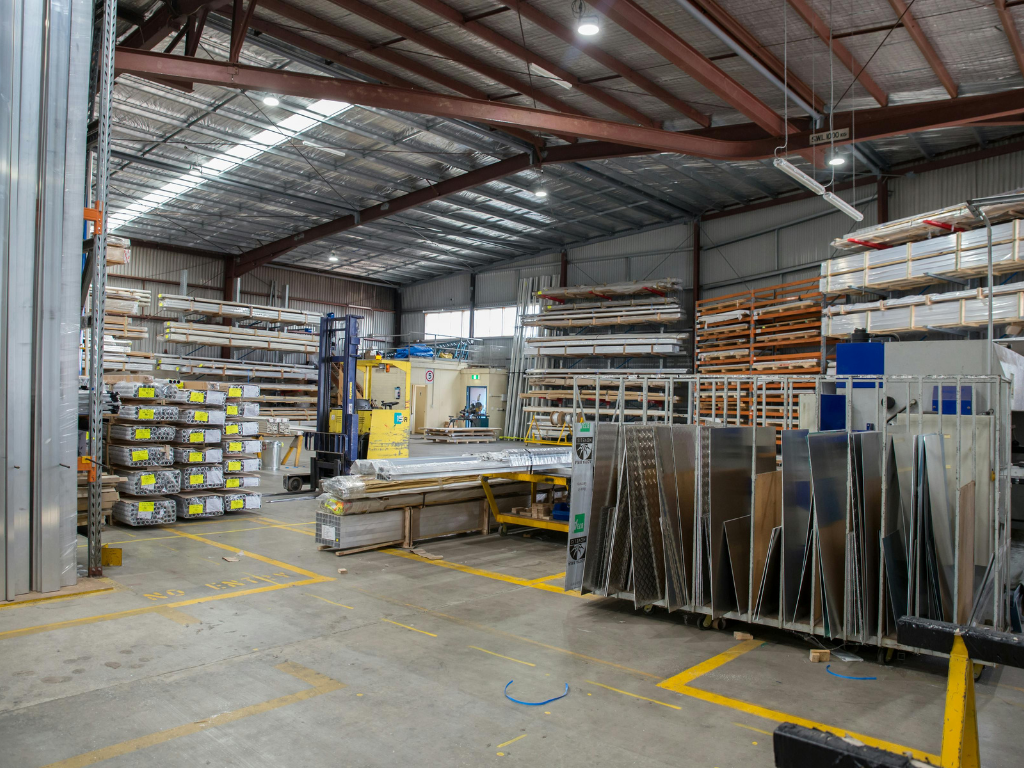
Steel service centre racking in Singapore has to solve a problem that standard pallet racks cannot: storing six-metre rebar bundles, three-tonne coils, and 12-metre I-beams in the same warehouse, all served by an overhead crane and a sideloader. This blog will walk you through how cantilever layout, cradle arm selection, and crane coordination work together in a Singapore steel stockholder warehouse.
Why standard pallet racking does not work for steel stockholders
Hot rolled bar, cold rolled coil, structural steel beams, sheet plate, and bundled rebar share three properties that defeat conventional pallet racking systems: they are too long for standard 2.7-metre beams, too heavy for typical 1,500 kg per pair pallet capacity at the upper levels, and they cannot be picked from the front like a pallet. The forklift cannot fork a 6-metre billet. The crane cannot reach into a four-beam-deep selective rack to lift a coil.
Steel service centres in Singapore solve this with cantilever racking, sometimes paired with heavy duty rack-supported cradles or coil saddles. The product configuration is covered in detail on NTL Storage’s cantilever racking system page, and the application logic for pipes, lumber, and steel is unpacked further in the existing post on cantilever racking for long loads. The decisions that matter most happen at the design stage, not at install.
How cantilever racking is sized for steel service centres
A cantilever bay has four design variables, and getting any of them wrong forces a redo. Column height, arm depth, arm capacity per pair, and column-to-column pitch. These four numbers determine whether the rack can carry the stock profile of a Singapore steel stockholder across its planned 15 to 20 year service life.
Column height and the crane bay constraint
Singapore steel service centres almost always operate under an overhead travelling crane. The cantilever column height has to leave headroom for the crane hook and the load below the hook, plus the sling clearance for whatever is being lifted onto the top arm. For a warehouse with 9 metres clear ceiling height and a 1.5-tonne overhead crane with 1-metre hook block, the practical cantilever column height tops out around 6 to 6.5 metres, which gives 4 to 5 arm levels at 1.2-metre spacing.
Going higher saves floor space but compresses the sling clearance, which slows every lift. Steel stockholders typically optimise for cycle time, not maximum density.
Arm depth and load profile
Standard cantilever arm depths in Singapore service centres run 1,000 mm, 1,200 mm, and 1,500 mm. The choice is driven by stock length, not weight. A 6-metre bar bundle on 1,200 mm arms is acceptable if the column pitch is 1,500 mm or less, because each bundle then sits on at least four arms with overhang inside the engineered limit (typically not more than half the arm depth at each end). A 12-metre structural beam needs columns at 1.5 to 2-metre pitch with arms not less than 1,200 mm.
Arm capacity per pair, not per arm
Cantilever capacity is quoted per pair of arms, because steel stock always spans at least two columns. A 1.5-tonne per pair arm rated at 1,200 mm depth typically corresponds to about 5 to 6 tonnes total capacity per level when spread across four to six arms. This is the number that matters for stock planning. The total load on the rack, not the load on a single arm.
The same logic applies to the floor anchor. A loaded cantilever transfers a high overturning moment into the column base, and the floor slab must take that without cracking. NTL Storage’s pallet racking load capacity calculation methodology covers the slab-loading side of the question, which applies to cantilever just as much as pallet racking.
Deflection limits and load testing
Arm deflection under full load should not exceed 1/200 of the arm depth, in line with the same family of EN-aligned standards Singapore inspectors apply to pallet racking. For a 1,200 mm arm that means under 6 mm deflection. Anything beyond is a sign of overload or arm fatigue and should trigger inspection. Most Singapore steel service centres load-test new cantilever installations to 1.5 times the rated working load before bringing them into service.
Cradle arms vs straight arms: choosing for the stock type
Straight arms work for bar bundles, beams, and pipes that are bound and held by their own weight. They fail for stock that wants to roll. That is where cradle arms come in.
Bundled rebar and steel bar
Straight arms with low front lips handle bundled rebar cleanly. The bundle weight holds the arm contact in place and the lip stops sideways slip during forklift transit. Most Singapore service centres stocking rebar in 6, 9, and 12-metre lengths use straight arms with 50 to 100 mm front lips and column pitch matched to the shortest standard bundle.
Hot rolled bar and structural beams
Same configuration as rebar, except arm capacity steps up. A standard 12-metre H-beam in S355 grade can run 200 to 800 kg per metre depending on section. Arm capacity at the front of the load bay needs to account for the bending moment plus a safety factor.
Cold rolled coil and steel rolls
This is where cradle arms or saddle cradles take over. Steel coils want to roll, and a flat arm makes that easy. Cradle arms have a V-notched or U-notched top face that locks the coil in place. Saddle cradles sit on top of the cantilever frame and hold the coil between two raised supports. For coils above 2 tonnes, a saddle cradle is the safer specification. Inverted saddles with non-marking polyurethane contact pads are common in cold-rolled service centres that handle surface-sensitive product.
Sheet stack and steel plate
Sheet plate is usually stored flat on heavy duty rack-supported decks, not on cantilever arms. The plates sit on cross-beams or solid decks at 100 to 150 mm pitch, with the overhead crane lifting via vacuum or magnetic lift. Cantilever sometimes appears at the back of a service centre for narrow plate or off-cut storage, but the workhorse for plate is a heavy duty rack with reinforced decking.
Crane coordination: designing the rack to live with the crane
The overhead crane is the second piece of capital in a steel service centre, after the building itself. The cantilever rack has to be designed around the crane, not the other way around.
Overhead crane bay clearance
Singapore Standard SS 497:2011 sets the code of practice for design, safe use and maintenance of overhead travelling cranes referenced by the WSH Council. The standard, together with the WSH (Operation of Cranes) Regulations, governs how the crane is operated and how clearances are maintained. From a racking design point of view, the practical constraints are the gap between the side of the rack and the crane runway, the headroom from the top of the highest loaded arm to the crane underside, and the lateral clearance for the hook to swing without striking the column.
A typical Singapore steel service centre layout leaves 800 mm to 1.2 metres between the cantilever column face and the crane rail, and 1.5 metres minimum between the top of the highest loaded arm and the crane runway beam underside. These numbers are not negotiable. Tighter clearances trigger stop-work orders during a WSH audit.
Sling clearance and pendant control
A two-leg sling lifting a 6-metre bar bundle off the second arm level requires sling clearance above the bundle equal to roughly the sling angle (typically 60 degrees) times the bundle length. For a 6-metre bundle that is 3 metres of vertical clearance from the top of the load to the hook before the sling angle is acceptable. Stack two arm levels too close and the lower bundles cannot be safely lifted out without rigging gymnastics that slow throughput.
Pendant-controlled overhead cranes need a clear walking path under the runway. Cantilever racks must not extend into the pendant operator’s path of travel. Most modern Singapore service centres have moved to radio-remote crane control to remove the operator from under the load, in line with HSE’s HSG246 recommendation on remote controllers, but pendant control still appears in older installations.
Single hoist versus double hoist crane workflow
The HSE published HSG246: Safety in the storage and handling of steel and other metal stock in its second edition with the National Association of Steel Service Centres, and it sets the international reference for stockholder operations. The guidance compares single and double hoist crane configurations. For Singapore steel service centres handling long stock, a double hoist crane (two hooks on one bridge) reduces the lift cycle by holding both ends of a 12-metre beam during cantilever loading. The racking layout has to accommodate the hook spacing of the double hoist, typically 4 to 6 metres centre-to-centre.
Updated lifting equipment regulations
MOM updated its statutory lifting equipment test and examination requirements in September 2025, with changes taking effect from 12 September 2025. The MOM press release on enhancing lifting equipment safety confirms revised requirements covering periodic testing of cranes, lifting machines, and lifting gears. Steel service centres operating overhead cranes should update their inspection regimes accordingly, alongside any cantilever rack inspection cycle. Crane-related lifting equipment options are summarised on NTL Storage’s material lifting equipment range.
Composite case study: Singapore steel service centre layout conversion
The following is an illustrative composite based on typical operations of mid-sized Singapore steel service centres in the West region, not a single named project. The pattern recurs across stockholders in Jurong and Tuas handling a mix of rebar, structural steel, and coil.
The starting setup: a 1,400 sqm flatted warehouse in Tuas with a 5-tonne overhead crane, 8.5 metres clear ceiling height, and stock held in floor blocks of bundled rebar and loose beam stacks. Floor utilisation around 60 percent, with significant honeycombing where 9-metre stock sat next to 6-metre stock in the same block. Pick time for a single beam averaged 8 to 12 minutes because the crane had to clear adjacent stock first.
The proposed layout: 18 cantilever bays running parallel to the long axis of the warehouse, 6-metre column height, four arm levels at 1.2 metres spacing, 1.5-tonne per pair arm capacity at 1,200 mm depth. Column pitch 1.6 metres for rebar and beam stock, widening to 2 metres at the structural beam zone. Sheet plate moved to a separate heavy duty rack at the back with reinforced decking.
The result expected from such a conversion: pallet positions (in the steel stockholder sense, defined as one indexed stock location) jump from roughly 80 floor blocks to approximately 280 indexed cantilever positions. Pick time per beam falls below 3 minutes once the crane no longer has to clear adjacent stock. Floor utilisation moves above 85 percent without expanding the warehouse footprint.
Numbers vary by stockholder, ceiling height, crane capacity, and stock mix. The pattern of going from floor blocks to indexed cantilever positions consistently delivers throughput gains that pay back the cantilever investment inside 18 to 24 months at Singapore industrial rents.
Examples of installed projects across various sectors are visible on NTL Storage’s past projects gallery.
Layout zoning for the steel service centre warehouse
A working steel service centre warehouse separates stock by handling profile, not by SKU class. Three zones recur in every functioning layout.
Long-load cantilever zone
The largest floor area, holding bar, beam, pipe, and bundled rebar on cantilever bays. Crane access from above, sideloader or counterbalance forklift access from the aisle. Aisle width matches the longest piece of stock plus 1.5 metres of swing clearance, typically 4 to 4.5 metres in Singapore service centres handling 12-metre beams.
Coil and roll zone
Saddle cradles or cradle-arm cantilever, served by the same overhead crane through a C-hook or coil-grab attachment. This zone is usually closer to the dispatch dock to minimise crane travel under load. Coils above 5 tonnes typically sit on floor cradles rather than cantilever, because the overturning moment exceeds standard cantilever ratings.
Sheet plate zone
Heavy duty rack with reinforced decks or floor stacks on dunnage. Magnetic lift or vacuum lift access from above. Sheet plate rarely goes on cantilever arms in Singapore service centres because the surface contact area is too small for stable storage.
Build-out and compliance checklist
A new cantilever installation for a Singapore steel service centre runs through the following sequence: site survey and crane bay measurement, structural slab assessment, cantilever bay design and PE endorsement where required, manufacturer order with 6 to 10 week lead time for heavy duty profiles, installation under crane lockout, load test at 1.5 times rated capacity, and final commissioning against SS 497 and SS EN 15635 inspection criteria.
The compliance file should hold the design calculation, the PE endorsement letter where the cantilever exceeds 6 metres or sits within a rack-supported structure, the manufacturer test certificate, the slab load capacity report, and the load test record. MOM auditors and the operator’s WSH consultant will both want these on file.
Conclusion
Steel service centre racking in Singapore is a coordination problem first and a storage problem second. The cantilever bay, the cradle arm choice, and the overhead crane workflow have to be designed together, or the operator pays for it in cycle time, throughput, and audit findings for years afterward. The right time to solve all three is at the design stage, not after the first sling-strike incident.
Get a Singapore-specific cantilever layout and crane coordination review from NTL Storage’s design and installation team before the next stock expansion, and the layout starts paying back from day one.
FAQ About Steel Service Centre Racking Singapore
What racking is best for a steel service centre in Singapore?
Cantilever racking is the standard choice for steel service centres in Singapore. It handles long stock like rebar, structural beams, and pipes that do not fit on pallet racks. For coils and rolls, cantilever pairs with saddle cradles or cradle arms. Sheet plate usually moves to heavy duty rack with reinforced decking instead of cantilever.
How do you size cantilever arms for steel bar storage?
Cantilever arm capacity for steel bar storage is sized per pair, not per arm, against the heaviest expected stock plus a safety factor of 1.5. Arm depth follows the longest stock length and column pitch, typically 1,000 to 1,500 mm depth at 1,500 to 2,000 mm column pitch. Deflection under full load should not exceed 1/200 of arm depth.
Why does crane coordination matter for cantilever racking design?
Cantilever racking and overhead cranes share the same workspace, and the rack height, hook clearance, and sling clearance all depend on the crane configuration. Singapore Standard SS 497:2011 sets the code of practice for overhead travelling cranes, and racks must be designed around the crane bay, runway, and hook block dimensions before installation.
What is the difference between straight arms and cradle arms?
Straight arms have a flat top face and handle stock that stays in place under its own weight, such as bundled rebar and structural beams. Cradle arms have a V or U-shaped notch on top that locks rolling stock, mainly coils and steel rolls, in place. For coils above 2 tonnes, saddle cradles on top of the cantilever frame are usually safer than cradle arms.
What standards apply to cantilever racking in a Singapore steel stockholder warehouse?
Cantilever racking in a Singapore steel service centre falls under SS EN 15635 for inspection and maintenance, the WSH Act Section 12 employer duty, and indirectly under HSE HSG246 produced with NASS as the recognised international guide for steel stockholder safety. Overhead crane operation falls under SS 497:2011 and the WSH (Operation of Cranes) Regulations.