
Boltless Rack Auto Parts Storage: Workshop Layout Guide
June 15, 2026
3PL Warehouse Racking Singapore: Multi-Client Layout Guide
June 18, 2026
In a 4-metre ceiling warehouse, every centimetre of headroom is contested between racking, sprinklers, and material handling clearance. Racking for 4 metre ceiling warehouse spaces almost always ends up as a binary choice: selective pallet rack with two beam levels, or a mezzanine that splits the building into ground floor and intermediate floor. This blog will walk you through when each layout wins, and where the actual storage density crosses over.
Why 4-metre ceilings are the Singapore industrial constant
A large share of Singapore’s industrial stock sits in B1 flatted factories with floor-to-ceiling height between 3.5 and 4.2 metres. These are the older JTC blocks at Tai Seng, Toa Payoh, Kallang, Ubi, and parts of Kaki Bukit. The clear ceiling height in many of them lands at 3.8 to 4.2 metres after deducting beams, lights, and services. Tenants moving into these units expect to install a warehouse racking system and are surprised by how little vertical room is actually usable once sprinkler clearance and forklift mast height are accounted for.
The constraint is not the storage problem. It is the headroom budget. A 4-metre clear ceiling has to absorb sprinkler clearance, beam thickness, pallet height, and the forklift’s lifted mast position without anything touching anything else. Operators who treat the ceiling height as a soft number always end up paying twice.
The headroom budget at 4 metres
The arithmetic for a 4-metre clear ceiling, working downward:
- Sprinkler heads typically sit 100 to 200 mm below the structural slab
- Minimum vertical clearance from top of stored goods to the sprinkler deflector under SCDF Fire Code 2023 Clause 6.4 on sprinkler installation and the relevant Singapore Standard CP 52 references for sprinkler spacing
- Top pallet height (the pallet itself plus the goods on it) of 1.4 to 1.7 metres for a typical 1,200 kg pallet
- Bottom of the top beam to the floor for the first pallet level
- Forklift mast lift height with the pallet at the top position
A clear 4-metre warehouse loses 500 to 700 mm immediately to sprinkler clearance and structural elements before any racking touches the floor. The usable storage height tops out around 3.3 to 3.5 metres. That is the working number that decides whether you can fit two pallet levels with a beam or whether the top pallet has to stop short.
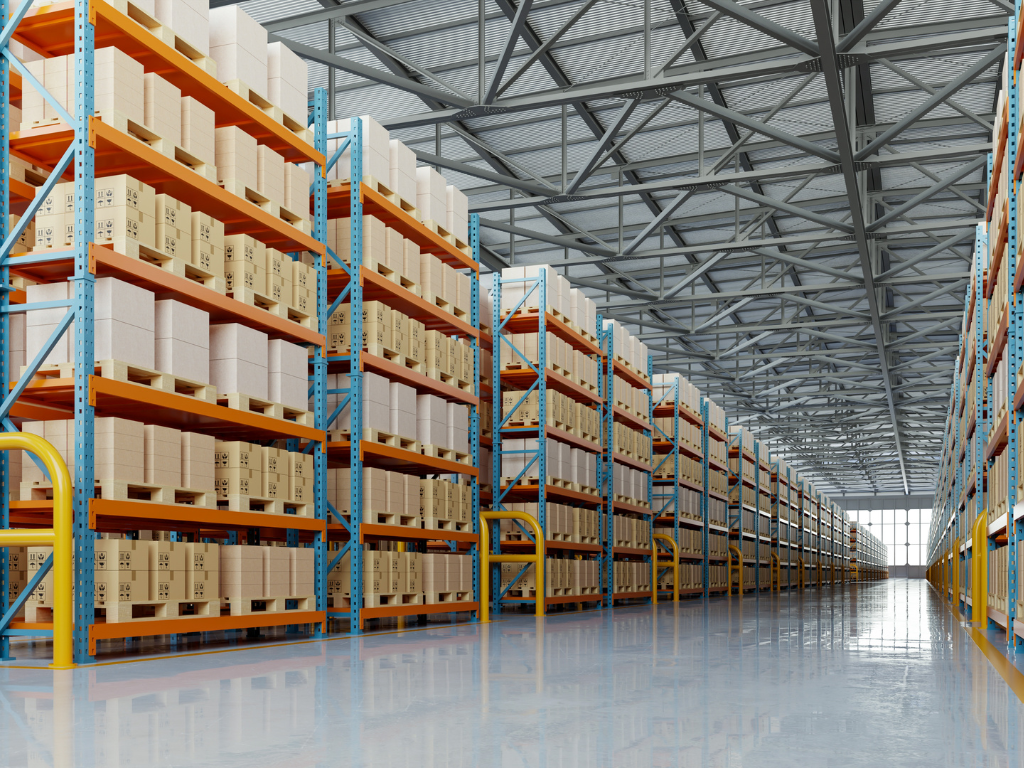
Two-level selective pallet racking in a 4-metre warehouse
Selective pallet racking is the default reflex for almost any warehouse project, and for good reason. Every pallet is directly accessible, every SKU can be picked without rotating stock, and the rack assembles and reconfigures quickly. In a 4-metre ceiling, the question is whether two pallet levels actually fit, and what the resulting density looks like.
What you get from two beam levels
Two beam levels in a 4-metre warehouse delivers roughly 2.5 to 3.5 pallet positions per square metre once aisles are subtracted, for standard selective racking at 1,000 mm aisle width or 2,700 mm aisle width depending on the forklift type. This is the bottom of the selective rack density range. Taller warehouses with 6 to 8 metre ceilings and 4 to 5 beam levels deliver 4 to 5 pallet positions per square metre at the same aisle width.
When two levels make sense
Two-level selective racking is the right call for low-to-medium SKU operations that need direct pallet access and where the stock profile cannot tolerate LIFO rotation. Distribution centres handling fast-moving consumer goods with frequent picking, parts distributors with high-value SKUs, and 3PLs with mixed-client inventory all need selective access more than they need raw density. The trade-off, accepting lower pallets-per-sqm against ceiling-restricted height, is acceptable when the rent on the unit is low enough to absorb it.
When two levels stop working
Two-level selective in a 4-metre warehouse breaks down when the operator is paying mid-market rent (above S$1.60 per square foot per month). At that rent, every wasted square metre is expensive enough that the analysis tips toward a denser layout. The same logic also applies when the SKU count is below 300 or so and inventory turns are slow enough that block stacking or drive-in is workable. The decision framework for picking between rack types is covered in NTL Storage’s selective versus drive-in racking guide.
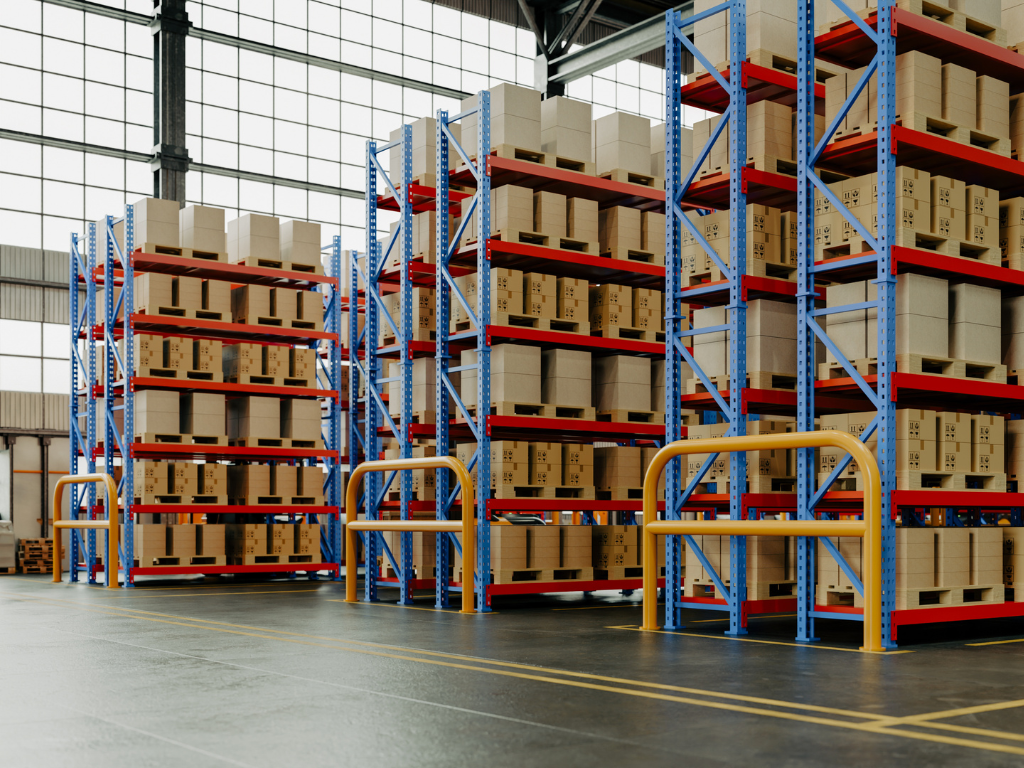
The mezzanine alternative in a low-ceiling warehouse
A mezzanine is an intermediate floor installed between the ground floor and the existing ceiling, splitting the available height into two levels. In a 4-metre warehouse, the mezzanine deck typically sits at 2.2 to 2.4 metres above ground, giving 1.4 to 1.6 metres of headroom on the upper level for shelving or light storage, with the ground floor reserved for pallet rack or heavier operations.
Why mezzanines work below 4 metres of ceiling
The trick is that a mezzanine does not require pallet-level headroom on the upper deck. The upper deck holds shelving, picking bins, light cartons, or non-pallet inventory. None of those need 1.5 metres of vertical space per level. NTL Storage’s rack-supported mezzanine platform is a common configuration for ceiling-restricted Singapore units, where the upright rack also doubles as the structural support for the upper deck.
Pallets-per-sqm after a mezzanine install
A two-level mezzanine effectively doubles the available floor area for shelving and bin storage, while leaving the ground floor available for selective racking. For a 1,000 sqm B1 unit with 4-metre clear ceiling, the storage capacity comparison runs:
| Layout | Ground floor storage | Upper level storage | Combined indexed positions |
| Two-level selective racking only | ~2,800 pallet positions | None | 2,800 pallet positions |
| Mezzanine plus ground-floor selective | ~1,400 pallet positions | ~600 sqm of shelving (4,000+ bins) | 1,400 pallets + 4,000 bins |
The mezzanine layout halves pallet capacity but adds the entire upper floor for non-pallet stock. For an e-commerce fulfilment site or a parts distributor where 70 percent of SKUs sit in cartons or bins rather than full pallets, the mezzanine layout delivers significantly more indexed positions per square metre of leased floor. Operators in similar situations often pair this with longspan shelving on the upper deck, which is the standard fit-out covered in NTL Storage’s longspan shelving page.
The headroom budget on a mezzanine
The arithmetic gets tighter. Mezzanine decking is typically 30 to 50 mm thick for steel grating or 18 to 25 mm for plywood deck on steel beams. The mezzanine beam depth itself adds 150 to 250 mm. In a 4-metre clear warehouse, a mezzanine deck at 2.4 metres above ground leaves about 1.6 metres of clear height below the upper-level ceiling, of which the upper-level operator loses another 200 mm to sprinkler clearance and lighting. The usable upper-deck height ends up at 1.3 to 1.4 metres, suitable for sit-down picking, bin storage, and light material handling but not for forklift work.
Density crossover: when mezzanine actually wins
The mezzanine-versus-selective decision in a 4-metre warehouse is not about which is denser in pallet terms. Selective beats mezzanine for raw pallet count. The mezzanine wins on total indexed positions when the SKU profile is varied and the bulk of stock is non-pallet.
Three signals point to a mezzanine being the right call:
Bin-and-carton dominant inventory. When more than 50 percent of stock sits in cartons or bins rather than on full pallets, the mezzanine upper deck delivers a higher count of working pick positions per square metre than any selective rack layout in a 4-metre warehouse.
Pick-pack operation with technicians or pickers walking the floor. Mezzanines turn a single-floor operation into a two-floor workflow, with picking happening upstairs and packing or dispatch downstairs. The walking distance per order falls, and the throughput per square metre lifts. The dispatch-buffer logic for e-commerce sites covered in NTL Storage’s racking layouts for online fulfilment in Singapore often points operators here.
Lease rent above S$1.60 psf per month. At higher rents, the cost of wasted floor area exceeds the cost of installing a mezzanine. The structural slab loading needs to support the mezzanine plus stock plus pickers, which in older B1 flatted factories with 7.5 to 15 kN/sqm floor loading is usually feasible for light to medium stock on the upper deck.
Compliance items that bite in a 4-metre warehouse
Three regulatory layers shape what is actually buildable.
SCDF Fire Code and 4-metre storage threshold
SCDF’s Fire Code 2023 Clause 9.8 for general warehouses under Purpose Group VIII sets specific requirements when displayed storage height exceeds 4 metres with sprinkler protection or 2.5 metres without sprinkler protection. A mezzanine that stacks storage on two levels has to be planned around this clause from day one. Sprinkler clearance below the mezzanine deck is also a separate non-negotiable check, since the underside of the mezzanine creates a second “ceiling” that needs its own sprinkler coverage in many configurations.
BCA mezzanine submission
Mezzanines that change the structural use of the building are treated as building works under BCA. For mezzanines above a certain area threshold or for rack-supported structures, the installation needs Professional Engineer (PE) endorsement and BCA submission before construction. Self-supporting selective racking under 6 metres usually does not need BCA clearance, but a mezzanine occupying more than a fraction of the floor area or carrying significant live load does. Operators planning their first install should also review the pre-installation checklist for warehouse racking to make sure nothing slips through the gap.
Floor loading and JTC unit limits
B1 flatted factories typically carry 7.5 to 15 kN per square metre floor loading. A mezzanine plus loaded selective rack plus a counterbalance forklift can exceed this in concentrated areas, especially under upright frames. The structural assessment matters more in flatted factories than in purpose-built ramp-up logistics buildings, where floor loading is rated higher.
When neither layout works and a different solution is needed
A 4-metre warehouse with high pallet velocity, low SKU count, and homogeneous stock is sometimes better served by drive-in racking or block stacking rather than selective or mezzanine. Drive-in delivers higher pallet density in low-ceiling units because it eliminates aisles, at the cost of LIFO rotation. Block stacking is even denser, at the further cost of crush damage to lower pallets and limited SKU separation. Both are worth considering when the stock profile fits, but neither matches the operational flexibility of selective racking or the multi-level usefulness of a mezzanine.
For specialist long-load stockholders working in low-ceiling units, cantilever along one wall combined with selective along another wall is a niche but useful hybrid layout. The cantilever takes long stock that does not fit selective beams, and the selective handles the rest.
Conclusion
Selective racking and mezzanines are not competing products in a 4-metre warehouse. They solve different problems. Selective wins when the stock is mostly pallets and the operator needs every position directly accessible. Mezzanine wins when the inventory is bin and carton dominant, the rent justifies an intermediate floor, and the operator has the SCDF and BCA paperwork in order.
Get a 4-metre warehouse layout designed around your actual stock profile by NTL Storage’s design and installation team, and the headroom budget stops being a constraint and starts being an asset.
FAQ About Racking For 4 Metre Ceiling Warehouse
Can you fit pallet racking in a 4-metre ceiling warehouse?
Yes, but typically only two beam levels. A 4-metre clear ceiling loses 500 to 700 mm to sprinkler clearance and structural elements before any rack touches the floor. Usable storage height is 3.3 to 3.5 metres, enough for two pallet levels with standard 1,000 to 1,500 mm pallet heights, not three.
Is a mezzanine worth installing in a low-ceiling Singapore warehouse?
A mezzanine makes sense when more than half of stock is bin or carton dominant rather than full-pallet, when rent exceeds S$1.60 psf per month, and when the floor loading is rated for the additional live load. In ceiling-restricted JTC B1 flatted factories, the mezzanine often doubles indexed pick positions without expanding the lease footprint.
What is the minimum sprinkler clearance for warehouse racking in Singapore?
SCDF Fire Code 2023 sets sprinkler installation requirements under Clause 6.4, and minimum vertical clearance between the top of stored goods and the sprinkler deflector is typically 500 mm, with 1 metre or more for ESFR systems. Storage above 4 metres in sprinkler-protected warehouses triggers Purpose Group VIII fire safety requirements under Clause 9.8.
Does a mezzanine need BCA approval in Singapore?
Mezzanines that exceed certain area thresholds or that carry significant live load require Professional Engineer endorsement and Building and Construction Authority submission before installation. Self-supporting selective pallet racks under 6 metres usually do not, but rack-supported mezzanines and large intermediate floors are treated as building works and must clear BCA review.
What floor loading does a B1 flatted factory typically have?
Most ex-JTC B1 flatted factories in Singapore carry floor loading between 7.5 and 15 kN per square metre. This is enough for two-level selective racking with light to medium stock and for most mezzanine installations with shelving on the upper deck, but heavy stock concentrated under upright frames needs a structural assessment before install.