Used Racking Systems vs New Purchase: Complete Guide
August 26, 2025
Selective vs Drive In Racking Singapore Guide
March 3, 2026
A warehouse racking installation timeline in Singapore typically runs 4 to 12 weeks from first site visit to final handover, depending on scope, design complexity, and steel lead time. This blog will walk you through every phase, from site survey to defect liability sign-off, so you can plan your fit-out without the hidden delays that catch most operators off guard.
How long does a warehouse racking installation actually take?
A small SME stockroom of 80 to 150 pallet positions, single-bay selective racking, no mezzanine, can be installed in 4 to 6 weeks end-to-end. Larger warehouse racking systems projects run longer: a 1,500-pallet drive-in or VNA install takes 8 to 12 weeks, and a rack-supported mezzanine with BCA submission stretches to 14 to 20 weeks.
These ranges assume nothing breaks. Site survey done in week one, drawings approved by week two, deposit paid, steel order placed, delivery slot confirmed. In reality, three things slow most projects down: late approval of structural drawings, forklift access conflicts with the existing operation, and steel arriving from China or Malaysia later than the lead time quoted. A realistic plan builds buffer for at least one of those.
The phases below are sequential, but design and procurement overlap once approvals come through.

Phase 1: Site survey and requirements gathering (Week 1)
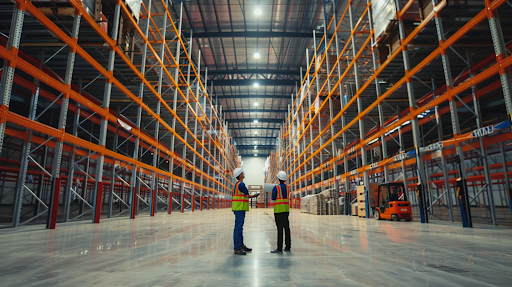
The site survey is where the project either gets specified properly or starts accumulating problems. A surveyor from the racking supplier walks the floor with the operations lead, confirms slab thickness and floor flatness (usually FF20 for selective racking, FF25 or better for VNA), measures clear height to the lowest obstruction (sprinkler, beam, fire detector, lighting), and checks column grid spacing.
Three things should be measured, not assumed: pallet dimensions, total pallet weight loaded, and the largest forklift mast height plus reach. A 1,200 mm by 1,000 mm Euro pallet at 1,200 kg behaves differently to a 1,100 mm SPC pallet at 800 kg. Get the wrong assumption here and the beam pitch is wrong six weeks later, after steel is already cut.
The kick-off meeting follows the survey, usually within 48 hours. This is where the operator confirms throughput targets (pallets in and out per hour), SKU count, FIFO or LIFO requirement, and whether cold storage, dust, or chemical exposure applies.
A good survey in Singapore takes 2 to 4 hours on site. A rushed one creates rework that costs weeks downstream.
Phase 2: Design, structural drawings, and quotation (Weeks 2 to 3)
Once requirements are fixed, the design team produces a layout plan, elevation drawings, beam-and-upright load calculations, and a quotation. For selective and double-deep systems, this takes 5 to 7 working days. For drive-in, VNA, or rack-supported mezzanine, expect 10 to 15 working days because seismic bracing, BCA submission inputs, and Professional Engineer (PE) endorsement add layers.
Drawings should specify upright frame profile and gauge, beam UDL ratings, frame anchor specification, base plate dimensions, and connector type. A quotation that lists “selective racking, 3 levels” without those numbers is incomplete and should be sent back.
Approval cycles are where timelines drift. Most operators need internal sign-off from operations, finance, and sometimes a parent company in another country. Build 5 to 7 working days into the schedule for this. Once the quotation is approved, deposit payment triggers steel ordering, which sets the next critical date.
Phase 3: Procurement and delivery scheduling (Weeks 3 to 6)
Lead time on steel is the longest single line item in the timeline. Selective racking components from regional suppliers (Malaysia, Vietnam, Indonesia) run 3 to 5 weeks ex-works. China-sourced steel runs 5 to 7 weeks ex-works plus 1 to 2 weeks shipping and customs. Fast-track jobs can use stocked components, but only for standard sizes. Reinforced uprights, custom beam lengths, and powder-coat finishes for cold storage all push lead times to the longer end.
Wire mesh decking, beam protectors, column guards, signage, and load notices are usually quoted separately and have their own lead times. They should be ordered the same week as the main steel, not at the end. The pallet racking cost breakdown shows where these line items sit relative to the main frame cost.
Delivery scheduling is coordinated with the warehouse operator’s receiving capacity and the install crew availability. Two trucks of upright frames blocking a loading bay during peak inbound is the kind of clash prevented at this stage, not on delivery day. A confirmed delivery slot, signed off by both supplier and operator, locks the install start date.
Phase 4: Installation and on-site assembly (Weeks 6 to 8)
Install crews work in two-person to six-person teams depending on bay count. Productivity in Singapore typically runs 30 to 50 pallet positions per crew-day for selective racking, 15 to 25 positions per crew-day for drive-in (more anchoring, more bracing per cubic metre), and 8 to 12 positions per crew-day for VNA on FF25 floors with tighter alignment tolerances.
A 600-position selective install with two 4-person crews finishes in 3 to 4 working days. A 1,500-position drive-in install runs 10 to 14 working days. Mezzanine installations add 1 to 2 weeks for deck panels, edge protection, and stairs.
Singapore-specific factors that affect on-site speed: night-only access for live warehouses, restricted forklift entry during install, lifting permit requirements for work above 5 metres, and fall protection for any work above 3 metres. The Workplace Safety and Health Act sets the baseline, and bizSAFE Level 3 contractors are the norm for industrial install work. MOM has been increasing inspection frequency on warehouse fit-outs, so non-compliant crews now lose 1 to 2 days to stop-work rectification.
The install crew also fits beam protectors, column guards, signage with load notices, and aisle markings. These are part of the install scope, not optional add-ons. Skipping signage at install is the most common reason rack inspection audits flag the system later.
Phase 5: Load testing, handover, and defect liability (Weeks 8 to 9)
Load testing in Singapore is usually a verification step rather than a formal test for selective and drive-in racking under EN 15512 design. The supplier confirms the rack is plumb (within 1/350 vertical tolerance), beams are level, anchors are torqued to spec, and load notices match the design drawings. A test pallet at rated UDL is loaded onto a sample bay to confirm beam deflection stays within design limits, typically 1/200 of span.
For mezzanine and rack-supported platforms, the rules are stricter. BCA structural plan approval is required before construction, and a BCA-endorsed structural plan submission signed off by a Qualified Person is what separates a legal mezzanine from a liability. SCDF Fire Code 2023 sign-off is a separate stream and adds 4 to 8 weeks for private property submissions. Skipping either is what caused the well-publicised Toa Payoh Industrial Park collapse in early 2025, where no submission had been made.
Project handover includes the as-built layout drawing, beam UDL certificates, anchor torque records, the maintenance schedule, and operator training on safe loading practice. Operators usually want to know how the documented UDL translates into actual pallet limits at each level, which is where the pallet racking load capacity guide earns its keep. A defect liability period of 12 months is standard with most Singapore racking suppliers. During this window, structural defects, weld failures, and connector issues are remedied at no cost. Wear and accidental damage from forklift impact are excluded, which is why a structured rack inspection routine starts immediately after handover, not 12 months later.
What slows down racking installation timelines in Singapore
Three causes account for most delays. First, scope changes after deposit. Adding 200 positions or switching from selective to drive-in mid-project resets steel ordering and pushes delivery 3 to 5 weeks. Second, slab condition discovered during install. A 150 mm slab without rebar reinforcement cannot anchor a 6 metre upright loaded to 1,500 kg per pallet position, and the fix (slab patching, deeper anchor specification, or epoxy chemical anchors instead of mechanical) costs 1 to 2 weeks. Third, forklift mismatch. The reach truck specified in the design is not the one available on site, and the install crew either waits or improvises, which is when accidents and rework happen.
Singapore-specific delays include CSOC (Construction Safety Orientation Course) certification gaps for new crews, WSH coordinator availability on multi-trade fit-outs, and warehouse landlord approval for floor anchoring on rented premises. Most of these are predictable and should be cleared during the survey, not on install day.
Conclusion
A warehouse racking project in Singapore is rarely about the steel itself. It is about how cleanly the survey, drawings, procurement, install, and handover stack together. Skip a step or rush approvals, and the timeline doubles. Specify properly upfront, and a 1,500-pallet selective install lands inside 8 weeks with a 12-month defect liability backing.
If you are scoping a new fit-out, a relocation, or a capacity expansion, talk to NTL Storage early. A site survey done in week one is what makes the rest of the schedule hold. Request a site survey and timeline quote before locking your steel order anywhere else.
FAQ About Warehouse Racking Installation Timeline
How long does a typical warehouse racking installation take in Singapore?
A selective racking project of 500 to 1,000 pallet positions runs 6 to 8 weeks from site survey to handover. Drive-in, VNA, and rack-supported mezzanine systems run 10 to 16 weeks because of structural drawings, BCA-endorsed PE input, and longer steel lead times from China or Malaysia.
What happens during a racking installation site survey?
The surveyor measures slab thickness and flatness, clear height to obstructions, column grid, and pallet specifications. The kick-off meeting confirms throughput, FIFO or LIFO, forklift class, and special conditions like cold storage. A complete site survey takes 2 to 4 hours and prevents rework during installation.
Do I need BCA approval for warehouse racking installation?
Standard pallet racking does not require BCA submission. Rack-supported mezzanines, mezzanine floors, and any structural floor loading change do require BCA structural plan approval and PE endorsement under the Building Control Act, plus separate SCDF Fire Code 2023 sign-off, before occupancy.
What is the defect liability period for racking installations?
The standard defect liability period in Singapore is 12 months from handover. It covers structural defects, weld failures, and connector issues. Forklift damage and operational wear are excluded, which is why scheduled rack inspections under SS 549 should begin immediately after handover, not at the end of the liability period.
Can installation happen during warehouse operating hours?
Yes, with constraints. Most live-warehouse installs use night shifts (10 pm to 6 am) or weekend windows to avoid forklift conflict and inbound disruption. Productivity drops by 20 to 30 percent on night shifts, so the timeline buffer should account for the slower pace and lighting limitations.